
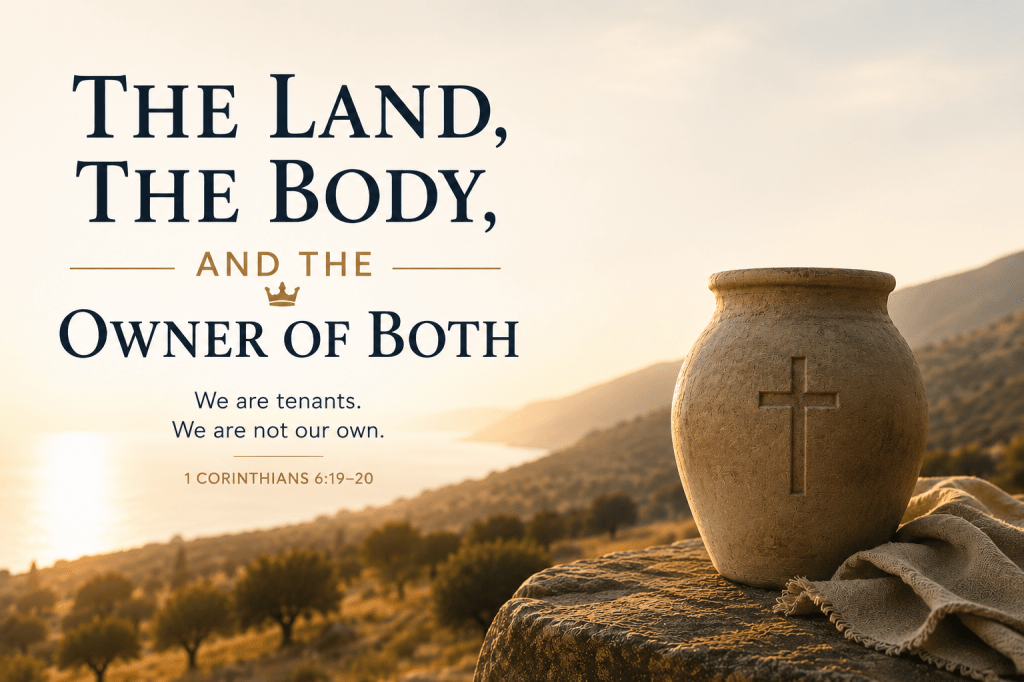

“The land is mine. For you are strangers and sojourners with me.”
Leviticus 25:23
The promised land was never Israel’s in the absolute sense. It was given to them, but it did not belong to them as though they could use it however they pleased. The land belonged to the Lord.
That matters because the law was not a religious code placed on top of Israel’s life. It was the instruction of the King for how His people were to live on His land. God had redeemed them from Egypt and brought them into a place they did not create, purchase, or deserve. They were not free to treat it as their own possession. Their worship, justice, sexuality, harvest, rest, debts, and care for the vulnerable all belonged before Him. To modern readers, the law can feel scattered, but beneath it all was one central truth: Israel was living before God, on God’s land, as God’s people.
They were being taught how to respond rightly.
Righteousness was not merely private morality. It was the right response to the God who owned them, delivered them, and dwelt among them. To keep the law was not to earn the land as a wage. It was to honor the King whose land they occupied. Their life in the land was meant to reflect His heart and nature before the nations (Deuteronomy 4:5–8).
When they left gleanings for the poor, they reflected His mercy (Leviticus 19:9–10).
When they judged fairly, they reflected His justice (Deuteronomy 16:18–20).
When they refused idols, they reflected His holiness (Leviticus 19:4).
When they rested on the Sabbath, they reflected His provision and rule over time (Deuteronomy 5:12–15).
When they honored marriage, life, blood, neighbor, and stranger, they were confessing that the land was not theirs to use however they pleased. It belonged to God, and their life upon it was meant to tell the truth about Him.
This is why rebellion in the land was so serious. Israel’s sin was not only personal failure. It was covenant treason. They were taking the King’s land and living as though the King had no claim over it. They were receiving His provision while refusing His rule. They were acting like owners when they were tenants.
The prophets understood this. Israel’s injustice, idolatry, violence, and sexual corruption did not remain hidden in private life. Their sin polluted the land and contradicted the God who had placed them there (Leviticus 18:24–28; Numbers 35:33–34). They were meant to be a holy people, but they used holy ground for rebellion.
Jesus presses this truth in the parable of the tenants (Matthew 21:33–46). The master owns the vineyard. He plants it, equips it, leases it, and expects fruit. The tenants are not condemned because the master was unjust, but because they refused his rightful claim. They wanted the vineyard without the owner. They rejected his servants. Then they rejected his son.
That parable exposes the deeper sin beneath human rebellion. We do not merely break rules. We try to live in God’s world as though God has no right to command us. We take what belongs to Him and treat it as our own possession.
The land was His. The vineyard was His. The fruit was His. The tenants owed Him a faithful return.
Paul applies this same truth more personally when he speaks about the believer’s body. Israel was called to live rightly on the land God had given them. The Christian is called to live rightly in the body Christ has purchased: “You are not your own, for you were bought with a price. So glorify God in your body” (1 Corinthians 6:19–20).
That is a hard word in an age that treats the body as the final property of the self. Scripture says something different. The body is not ultimate private territory. It is not a tool for self-expression without reference to God. It is not a prison to escape or an idol to worship. For the Christian, the body is a temple of the Holy Spirit, purchased at great cost by the blood of Christ.
We are not our own.
We are sojourners, even in these temporary tents of flesh (2 Corinthians 5:1; 1 Peter 2:11). Our bodies are real gifts, but they are not permanent homes. We live in them, serve through them, suffer in them, obey with them, and one day they will be raised by the power of God.
Until then, they belong to the Lord.
Christian obedience is not a shallow attempt to keep religious rules. It is the right response of a purchased people. We have been set free from slavery to sin and brought into slavery to righteousness, no longer offering our bodies as instruments of rebellion, but as instruments of service, mercy, holiness, truth, and love (Romans 6:13, 17–19). Israel was called to honor God in the land He had given them. The Christian is called to honor God in the body Christ has redeemed.
So the hands matter. The mouth matters. The eyes matter. The appetite matters. The habits formed in secret matter. The way we work, rest, speak, spend, serve, confess, repent, and endure all belong before God.
The Christian is an ambassador of Christ (2 Corinthians 5:20). Our lives are meant to represent Another. We do not belong to the kingdoms of self, appetite, approval, lust, greed, fear, or comfort. We belong to the King who purchased us. Our conduct should make His goodness visible. Our obedience should redirect attention to His rule. Our lives should be salt and light, not drawing attention to ourselves, but pointing back to the Master and Owner of all things (Matthew 5:13–16).
Israel was called to live on God’s land in a way that reflected God’s heart.
Christians are called to live in God’s world, in bodies purchased by God’s Son, in a way that reflects the same holy and gracious King.
The land was never merely land.
The body is never merely a body.
Both belong to the Lord.
 Breakwater Blessings
Leave a comment