
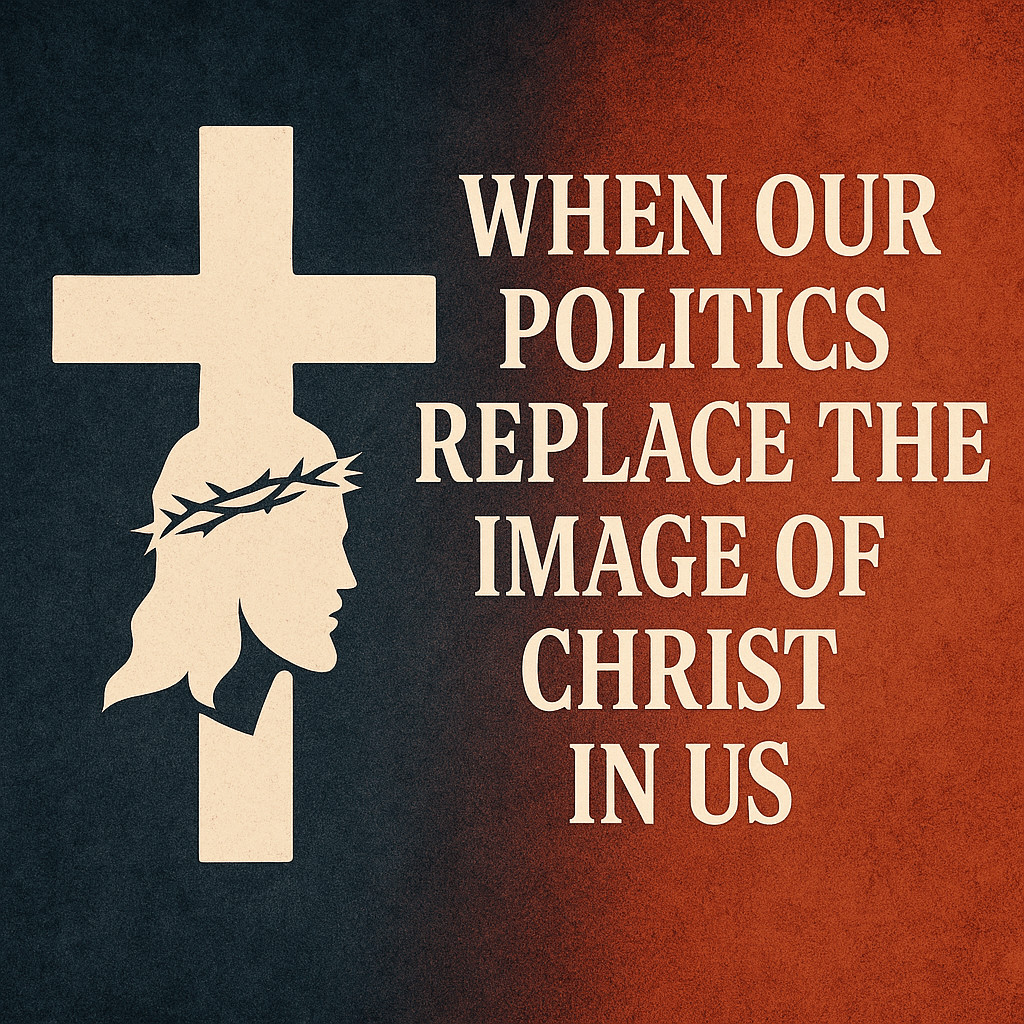

There is a dangerous exchange happening in the church right now. Many Christians are allowing politics to form their instincts, language, priorities, and loyalties more than Christ does.
Christians should care about the world we live in. We should care about laws, leaders, justice, life, truth, mercy, and the good of our neighbors. The problem begins when political allegiance starts discipling us more deeply than Jesus does. When that happens, we start deciding which sins bother us, which injustices deserve attention, which people are worth defending, and which commands of Christ can be quietly minimized.
Christians on the left and Christians on the right can both fall into this. The issue is deeper than party affiliation because it concerns whether Christ actually governs our loves, fears, words, and loyalties.
Jesus said the entire Law hangs on two commands:
“Love the Lord your God with all your heart and with all your soul and with all your mind. This is the first and greatest commandment. And the second is like it: Love your neighbor as yourself.”
Matthew 22:37–39
Those commands are not private religious thoughts that sit apart from public life. They have authority over every part of the Christian life, including what we support, what we oppose, how we speak, how we vote, how we treat people, and what we are willing to excuse.
If my politics cause me to violate either of those commands, my politics need correction, even when my side tells me I am right.
Political allegiance can become like tinted glass over the heart. Scripture may still be open in front of us, but we begin to notice only the parts that confirm our side and soften the parts that correct us. Over time, we can start reading God’s Word through our political instincts instead of allowing God’s Word to confront and reorder those instincts.
That is dangerous because Scripture does not belong to any party. Christ does not submit Himself to our preferred platform. He stands over every human authority, ideology, nation, and movement. The Christian does not get to bring Jesus in as support for a political identity that is already settled. We come under His authority first, and everything else has to be tested there.
When Truth Is Spoken Without Love
We are called to speak truth, but truth spoken without love can damage the very witness we think we are defending.
Hebrews 4:12 says the Word of God is living and active, sharper than any two edged sword. God’s Word pierces, but it pierces with holy purpose. It exposes sin, brings conviction, calls people to repentance, and leads them toward grace. It was never given to us so we could humiliate people in arguments or use Scripture to make ourselves feel superior.
Too often, Christians think they are defending the faith when they are really defending their pride.
We post before we pray. We argue before we listen. We label people quickly and rarely ask whether our words are helping them see Christ more clearly. We can become more interested in winning a point than loving a person made in the image of God.
That should trouble us.
When we speak with venom, mockery, or contempt, we give a watching world a distorted picture of Jesus. We may be saying true things, but our manner can still deny the character of the One we claim to represent. Paul says in 1 Corinthians 13 that even if we understand mysteries and have knowledge, without love we are nothing. A loveless defense of truth may still sound religious, but it does not reflect the heart of Christ.
Brennan Manning once said:
“The greatest single cause of atheism in the world today is Christians who acknowledge Jesus with their lips, walk out the door, and deny Him by their lifestyle. That is what an unbelieving world simply finds unbelievable.”
That warning is uncomfortable because it reaches into ordinary Christian behavior, including the way we talk about politics.
Our political engagement, whether online, in conversation, or in the voting booth, should make Christ more visible rather than less. If my political tone makes Jesus seem petty, cruel, careless, or contemptuous, then I am not representing Him well. If my activism points people more clearly to my party than to the cross, then politics has begun taking more of my heart than it should.
That is how idols often work. They do not always announce themselves as replacements for God. They slowly train our loves, fears, anger, hopes, and loyalties until we are more disturbed by threats to our side than by the ways we are failing to obey Christ.
The People God Tells Us Not to Forget
God has always commanded His people to care for those with little power and little voice: widows, orphans, the poor, the oppressed, and the outsider.
Isaiah 1:17 says:
“Learn to do good; seek justice, correct oppression; bring justice to the fatherless, plead the widow’s cause.”
James 1:27 says that pure and undefiled religion includes caring for orphans and widows in their distress.
That means we cannot care about life, justice, mercy, or truth only when those words are useful to our side. We cannot defend the vulnerable selectively and still claim that our concern is shaped by the heart of God. If a person matters to God, that person cannot become expendable to us because of political convenience.
Paul says we are ambassadors for Christ.
“Therefore, we are ambassadors for Christ, God making his appeal through us.”
2 Corinthians 5:20
That means we carry His name into every space we enter, including political spaces. Our words, votes, advocacy, tone, and treatment of others all say something about the One we claim to follow.
If my political identity becomes more visible than my identity in Christ, I have lost my way.
No political party will stand before the throne of God on my behalf. I will stand before Him. So will you. That should sober us. It should make us slower to excuse sin when it helps our side, slower to mock people Christ calls us to love, and more willing to let Scripture correct us before we use it to correct others.
If we follow Jesus, our faith must govern our politics. Our love for God and neighbor has to reach into our opinions, our language, our loyalties, and our public witness.
We should speak truth, but we should speak it as people who have received mercy.
We should stand for what is just, even when our side is inconsistent.
We should refuse to let politics make us despise people God has called us to love.
At the end of all of this, no one answers to a party, a movement, or a culture.
Each person answers to Christ.
That should shape what Christians take seriously, what they overlook, and what they allow to form them.
 Breakwater Blessings
Leave a comment