
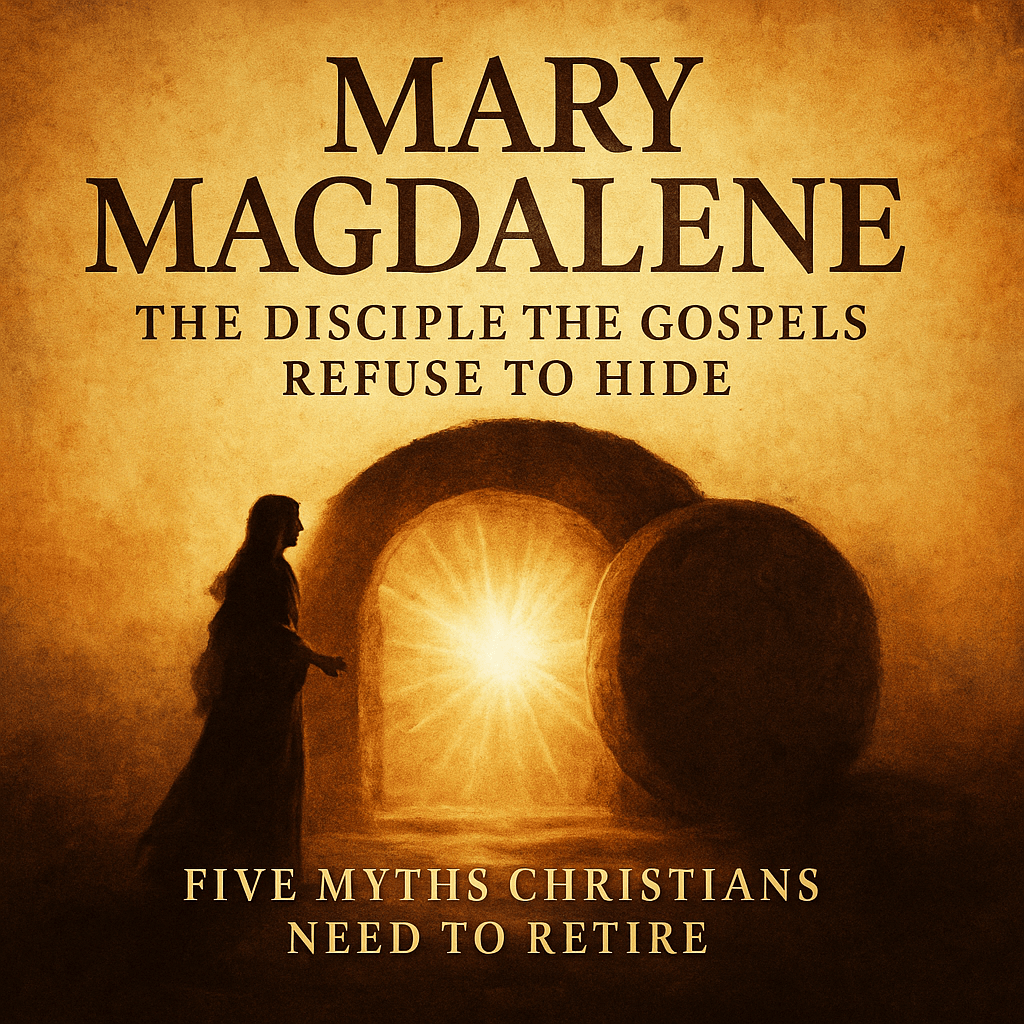

It is a shame how much rumor and pop fiction we have piled onto Mary Magdalene. The noise drowns out the plain, powerful truth. The Gospels give us a healed woman who followed Jesus with her substance, stood near when others scattered, and carried the first Easter announcement. And that last detail matters in a historical way. In a world where the testimony of women was often discounted, the evangelists put a woman at the center of the discovery and named her. That is not how you craft a convenient legend. That is how truth sounds when it refuses to be edited. That is the legacy worth defending.
1) Myth: “Mary Magdalene was a prostitute”
What Scripture says: Luke records that Jesus cast “seven demons” out of “Mary called Magdalene,” then names her among the women who traveled with Him and materially supported the mission (Luke 8:1–3). That is the record.
Where the myth came from: In 591, Pope Gregory the Great preached a homily that blended three different women, the unnamed “sinful woman” of Luke 7, Mary of Bethany, and Mary Magdalene. That conflation shaped Western imagination for centuries, even though it is not what the Gospel texts say. For a mainstream reference that notes Gregory’s role and the modern correction, see Encyclopaedia Britannica on Mary Magdalene.
Why it matters: When we sexualize a female disciple by default, we silence her witness and preach our bias instead of the Bible.
2) Myth: “She is the woman with the alabaster jar”
What Scripture says: The anointing scenes involve either unnamed women or Mary of Bethany, not Mary Magdalene. Compare Luke 7:36–50; John 12:1–8; Mark 14:3–9; Matthew 26:6–13.
What history says: Standard references separate these figures and explicitly note the old Western habit of conflating them. Again, Britannica summarizes the distinction and the later confusion that began with Gregory’s sermon.
Why it matters: Conflating women in the Gospels makes their individual callings disposable. Mary Magdalene does not need borrowed perfume to matter.
3) Myth: “She was Jesus’ wife”
What Scripture says: The New Testament never hints at a marriage. Mary’s importance flows from discipleship and commissioning, not romance. See John 20:11–18 for the resurrection encounter and sending.
What the evidence shows: A 2012 papyrus nicknamed the “Gospel of Jesus’s Wife” made headlines, then collapsed under investigative scrutiny. The Atlantic’s 2016 deep dive documented fabricated provenance and led the announcing scholar to concede the evidence now presses in the direction of forgery.
People also cite the Gospel of Philip, a third century noncanonical text that calls Mary a koinōnos (companion) and includes a damaged “kiss” line, hardly marital proof and centuries late. Read a scholarly English translation to see the lacuna for yourself.
Why it matters: Explaining Mary’s significance by marriage diminishes her actual calling. She mattered because she followed, stayed, and was sent.
4) Myth: “There is a hidden bloodline in France and a secret society guarding it”
What Scripture says: Mary’s testimony is public, not esoteric. “I have seen the Lord,” then a mission to tell the brothers (John 20:11–18).
What history says: French legends about Provence are late tradition, and even Britannica flags them as spuriously attached to her story.
The modern “bloodline” conspiracy rides on the Priory of Sion hoax and pop history like Holy Blood, Holy Grail. Credible reporting has treated the Priory claims as fabricated modern lore, not ancient evidence.
Why it matters: Chasing secrets keeps us from the public proclamation she actually carried, the first Christian confession of Easter.
5) Myth: “The church erased her and only moderns rescued her”
What Scripture says: She is named at the cross, the burial, and the tomb. John centers her personal encounter with the risen Christ and her commission to announce the resurrection (Mark 15:40–47; Matthew 27:55–61; Luke 24:1–10; John 20:1–18).
What the church actually did: In 2016, the Holy See elevated her memorial to the rank of Feast and published a new preface highlighting the ancient title “Apostle to the Apostles.” Read the Vatican Press Office bulletin and the decree.
Why it matters: The better story is remembrance, not erasure. Honor the woman Christ chose to be first with the message.
What the text gives us to celebrate
- A healed disciple who followed and gave. Luke names her among the women who traveled with Jesus and used their resources for the mission (Luke 8:1–3).
- A courageous presence at Golgotha and at the tomb. She stayed near when many fled, then came early in love and devotion (for example, Mark 15:40–47; John 20:1).
- The first resurrection witness and the first commission. She heard her name, recognized His voice, and was sent to tell the brothers (John 20:11–18).
Mary Magdalene does not need our embroidery. She needs our attention. See her as the Gospels give her, a woman Jesus healed, a disciple who gave, a witness who spoke first. When we honor that, we honor the Lord who called her by name and trusted her with Easter.
Notes for readers who want to go deeper
- Encyclopaedia Britannica — “Mary Magdalene”
- Pope Gregory I — Homily 33 on the Gospels
- The Atlantic (Ariel Sabar, 2016) — “The Unbelievable Tale of Jesus’s Wife”
- Gospel of Philip — in The Nag Hammadi Scriptures, ed. Marvin Meyer
- Holy See Press Office, June 2016 — Bulletin on St. Mary Magdalene’s Feast
- Congregation for Divine Worship, June 2016 — Decree Apostolorum apostola
- Encyclopaedia Britannica — “Holy Blood, Holy Grail”
- CBS News, 60 Minutes — coverage of the Priory of Sion hoax
- Encyclopaedia Britannica — “New Testament apocrypha”


Leave a comment