
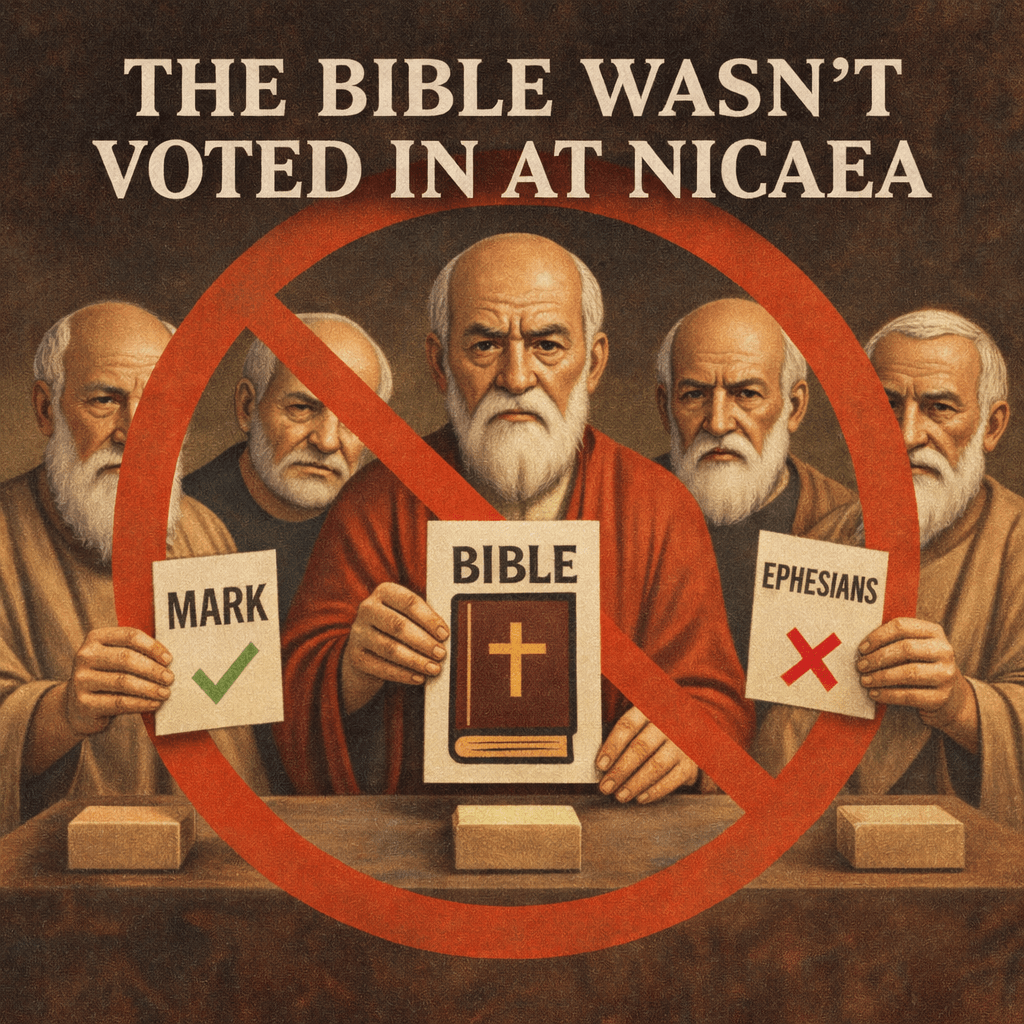

The Council of Nicaea (325 AD)
Thanks to the works of Dan Brown in his fictional novel The Davinci Code, as well as the development of social media, the notion of the Council of Nicaea (an ancient Greek city) deciding the Biblical canon containing 66 books of authoritative Scripture is still gaining traction. Many of those who label themselves as “deconstructionists”, those who were once professing Christians but now have left the faith, declare that the Christian faith, and the Bible as a whole, was decided at the Council of Nicaea in 325 AD by Emperor Constantine for political reasons. Not only is this idea false, but there is no historical or evidential basis for this claim.
How did we get the Biblical canon?
First, let’s take a look at how the canon was understood prior to the 300s AD. It is widely acknowledged by both Christian and non-Christian scholars that all 27 books of the New Testament were written prior to 100 AD. Most of them are conservatively dated prior to 70 AD for several reasons. Between 95 AD and 110 AD, three of the early church fathers; Clement of Rome, Ignatius, and Polycarp, quote 25 out of 27 of the NT books in letters that they write confirming the books as authoritative Scripture. Jude and 2John were later recognized as authoritative, as Jude was Jesus’ half-brother. 3 John was of the books quoted, so naturally this would place 2 John prior to 3 John. Throughout the centuries, the early church was attentive to which books carried authority for faith in practice in the Church by testing them against certain criteria, ensuring they came from someone who was an apostle or a close associate of an apostle (i.e. Luke). After the 2nd century, other gnostic gospels (Peter, Mary, Judas, Thomas, etc) were rejected by the Church for many reasons. One, the early church fathers never affirmed them, since these works were written much later (after 200AD), did not come from the communities that were properly vetting the books, and the content in these books did not match the character or works of Christ and were discovered to be forgeries by writers who stole names of prominent figures within Christendom. By the time 300 AD rolled around, the books of the Bible were still independent of one another at this time, but the 27 books of the New Testament had been recognized as authoritative for almost 200 years.
What happened leading up to the Council?
Roman Emperor Constantine the Great reigned from 306 AD – 337 AD. Prior to this, Emperor Diocletian reigned between 284 AD – 305 AD. Toward the end of his tenure, Diocletian became the worst persecutor of Christians since Nero (54 AD – 68 AD). He burned churches, took homes from Christians and arrested or put many to death many, many others. After Diocletian’s death, Constantine rises to power, and in 312 AD he becomes a believer in Christ. A year later, he issues the Edict of Milan which formally legalized Christianity and all religions inside of the mostly pagan Roman Empire. After this happens, debates start to arise as to the nature of Jesus Christ. The biggest point of contention came from a Presbyter in Alexandria named Arius, who strayed from the orthodox view of the Father, Son and Holy Spirit being co-eternal, triune persons while one in being. Arias posited the belief that Jesus was a created being and not co-eternal with the Father. This began to create tension and fighting with Archbishop Alexander and Athanasius who represented the Orthodox position. As opposed to some of his predecessors, Constantine did not desire to reign with terror or have division within the Empire, so Constantine later convened the Council to held in Nicaea in 325 AD.
What happened at the Council?
Hundreds of bishops and church leaders from across the Empire were called to the Council to reconcile their doctrinal differences with Arius and a small number of his followers. While the Arian Controversy was the main topic, several other issues were ironed out as well. Arias’ belief, now dubbed Arianism, was overwhelmingly declared to be a heresy and he was anathematized along with two others. The Nicene Creed was written to affirm Christ’s co-eternal divinity; “…of one substance with the Father…” Second, a uniform date for Easter was established, as the Church wished for the celebration to occur on a Sunday which initially proved difficult because of the way the Jewish Passover fell each year. Third, 20 laws that governed behavioral and moral conduct of the clergy were established as well.
So, when did they vote on the books of the Bible at the Council?
In spite of all of what happened at the Council, keeping in mind all of the Canonical history laid out in the beginning of this summary, the Council of Nicaea never discussed the books of the Bible, never mind voted on anything regarding the Canon of Scripture. According to all the writings that came out of Council, there is no evidence to show that the books of the Bible were “decided” or “determined” as authoritative. The late New Testament scholar Bruce Metzger put it this way: “The Church did not determine what was in the Canon, they discovered what was in the Canon. The Bible is a list of authoritative books, more than it is an authoritative list of books.” Thanks be to God for preserving His word, and that His word is truth. Even if lies are said often enough, or made into books and movies, they will not become true.
 Breakwater Blessings
Leave a comment