
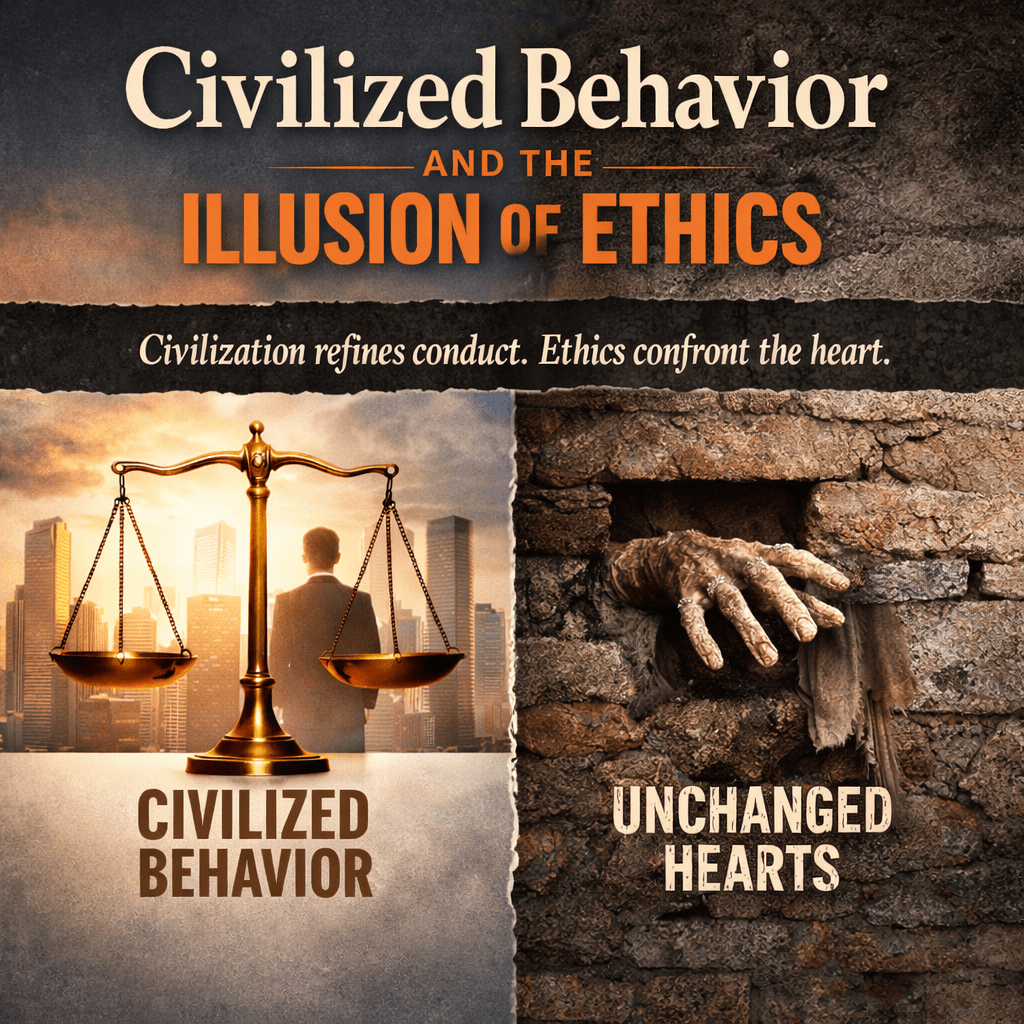

There is an assumption in modern culture that we are more ethical than the generations before us. We speak more carefully. We emphasize tolerance. We build systems, policies, and procedures meant to reduce harm. Against the backdrop of older forms of brutality, we appear more measured, informed, and humane.
That appearance should not be confused with moral change.
What we often call ethics is, in many cases, civilization doing its work. We are not necessarily less sinful than those who came before us. We are more regulated, more restrained, and more conditioned to operate within accepted social boundaries.
Scripture does not treat improved behavior as evidence of a healed heart. Jeremiah says the heart is deceitful above all things and desperately sick. That remains true even when conduct becomes more refined.
Civilization can shape behavior at the social level.
It cannot cleanse the inner man.
Ethics, in the biblical sense, reaches into motive, desire, and worship.
That distinction matters when people begin to question whether the justice of God is still necessary. If humanity appears improved, divine judgment can start to feel excessive. If we seem decent, self-aware, and morally progressing, grace can begin to look unnecessary.
Scripture does not locate the human problem in the amount of sin. It locates it in the condition from which sin comes. God does not judge by outward appearance. He looks at the heart. That is where Jesus directs attention in the Sermon on the Mount.
He takes commandments people assumed they understood and drives them inward. Murder is traced back to anger. Adultery is traced back to lust. Sin is present before the visible act because the act comes from a heart already turned out of order. Jesus is not adding new intensity to the law. He is showing what was always there. The law was never concerned only with public conduct. It always addressed the person before God.
That was especially unsettling for the Pharisees.
They developed layers of additional rules intended to keep people from approaching sin. Over time, those rules became the focus. Righteousness was measured through visible compliance, social distinction, and public presentation. The result was a kind of order that could impress others while leaving the heart untouched.
Jesus did not come to dismiss the law. He came to fulfill it and reveal its true reach. When he called the Pharisees whitewashed tombs, he was identifying a deeper reality. A person can look clean, disciplined, and devout while remaining inwardly dead. External order is not the same thing as spiritual life.
That is what made the Pharisees so tragic. Their religion became detailed enough to dull their sense of need. They had practices, categories, boundaries, and visible seriousness, yet all of it could function in a way that kept them from recognizing their need for grace.
The same pattern is easy to see now.
Under secular humanism, people are taught to view humanity as fundamentally good, morally developing, and in need of support more than rescue. Sin is recast as dysfunction, immaturity, or misalignment. Guilt becomes something to manage or remove psychologically. Redemption becomes a project of self-improvement.
Once that framework is in place, the cross begins to lose its meaning. If the human problem is mainly lack of education, affirmation, or social progress, then atonement feels unnecessary. Judgment feels outdated. Grace feels excessive.
Scripture does not allow that confidence. Paul says there is none righteous, not even one, and that all have sinned and fall short of the glory of God. This does not deny that societies can become more orderly or that individuals can become more outwardly disciplined. It denies that any amount of refinement can address the root problem.
That is why the teaching of Jesus continues to confront us. Before a person can receive the grace of God in Christ, he must see that he needs more than correction. He needs mercy. Grace is not given because someone has become civilized enough to deserve help. Grace is God’s answer to sin and death. It does not improve the surface. It gives life to those who are spiritually dead.
The Pharisees largely missed that because their system shielded them from it. Modern people can miss it in a similar way, though the language is different. We confuse behavioral progress with moral healing. We assume that because we are more careful, less publicly brutal, and more conscious of appearances, we must also be more righteous.
But the heart is not healed by management.
That is why the Sermon on the Mount is merciful. Jesus removes the illusion that outward decency can reconcile us to God. He removes the comfort of appearances so the truth can be faced. Civilization may restrain certain expressions of sin. Only grace deals with the sinner himself.
Until that need is seen, the justice of God will feel unnecessary and the grace of God will feel excessive.
Once it is seen, grace is no longer offensive.
It becomes astonishing.


Leave a comment