

Prayer is something we know we should prioritize. Most of us want to. We also understand how this works in every other relationship. If there is no communication, the relationship stays thin. We know prayer is central to relating to God. The harder part is living that out.
Many of us recognize the value of prayer and still struggle to pray. We can agree it matters and still avoid it. Sometimes the obstacle is obvious. We are busy, distracted, tired, and keep pushing prayer to later. Sometimes it is less obvious. We feel distant from God and do not know how to reenter. We feel guilty and do not want to face it. We feel numb, and prayer sounds like effort with no payoff. Even the desire to pray feels missing. That gap is real. It is one of the most common experiences in the Christian life.
Lord, Teach Us to Pray
Luke 11 starts with something simple. The disciples ask Jesus, “Lord, teach us to pray” (Luke 11:1). They are not asking for a lecture on why prayer matters. They are asking for help entering it. They have watched Jesus pray, and still they know they need to be taught. Jesus answers them with words, and then He answers them with a promise about what God gives when we pray.
He begins with a pattern.
Father
He teaches them to say, “Father” (Luke 11:2). That one word takes language Israel already knew and makes it newly personal. Prayer is not first a religious exercise. It is a child coming to a Father. That matters because many of us approach prayer as if God is distant, easily irritated, or hard to please. Jesus does not teach us to come that way. He teaches us to approach God as Father.
Hallowed Be Your Name
Then He teaches them to begin with God Himself. “Hallowed be your name” (Luke 11:2). That is not filler. It is reorientation. When you come into prayer anxious, self-focused, or scattered, naming God as holy pulls you out of the small room your mind has built. It reminds you who you are dealing with. It also reminds you that you are not running your life alone.
Your Kingdom Come
He moves into kingdom language. “Your kingdom come” (Luke 11:2). That line slows down the instinct many of us have in prayer, which is to push our needs immediately to the front. Jesus does not deny those needs. He teaches us to place them inside a larger reality. God has a kingdom. He is doing something in the world and in His people. When we pray for the kingdom, we are asking Him to rule our lives, shape our loves, and reorder what we are aiming at. That is not abstract. It lands in ordinary decisions, habits, and relationships.
Daily Bread
Only after that does Jesus put daily needs on our lips. “Give us each day our daily bread” (Luke 11:3). He teaches us to ask plainly for what we need. Not once in a while. Daily. That corrects the way many of us live. We try to hold ourselves together until we cannot, then we scramble for help. Jesus teaches a steadier dependence for the provisions we need to live.
Confession and Forgiveness
Then He brings in confession and forgiveness. “Forgive us our sins” (Luke 11:4). If you are in Christ, that request sits inside something already settled. Christ has paid for sin fully, and when you trust Him, you are forgiven (Ephesians 1:7; Colossians 2:13–14). Past, present, and future. Your standing with God is not hanging by a thread every time you fail. You are not coming to prayer to requalify for relationship.
So why confess? Because forgiveness is not only a legal status. It is also a lived relationship. Confession is part of sanctification. It is how we bring what still clings to us into the light, stop defending it, and agree with God about it. It clears the fog that sin and shame create, and it restores fellowship at the level of the heart (1 John 1:9). We are not asking God to become willing again. We are coming back to what is already true in Christ, receiving it again with humility, and letting grace do its work in us.
Jesus also connects receiving mercy to extending mercy. Luke phrases it this way: “for we ourselves forgive everyone who is indebted to us” (Luke 11:4). That is not a way of earning forgiveness. It is the shape forgiveness takes when it has actually reached the heart.
Temptation
He also teaches us to pray about temptation. “Lead us not into temptation” (Luke 11:4). That line assumes weakness, and it assumes God’s help. It trains humility and watchfulness. You are admitting you can be pulled. You are asking God to guard you and keep your heart faithful.
Jesus gives a pattern grounded in real life. It starts with God, then moves through the things we actually carry each day: provision, sin, and temptation. It gives words for the times we sit down to pray and realize we have nothing coherent to say.
Ask, Seek, Knock
Luke 11 does not end with a prayer template. Jesus goes on to ask, seek, and knock, and the focus shifts from the shape of our prayers to the character of the Father we are praying to (Luke 11:9–10).
He talks about persistence, but the weight of His argument is not in the persistence. It is in the Father. He uses examples from family life. If a child asks for food, a normal father does not hand him something harmful (Luke 11:11–12). Jesus is not making a sentimental point. He is laying down a baseline of what fatherhood means, then showing that the heavenly Father is better.
Then He ends with a line that can surprise people if they think of prayer only as request and outcome. He says the Father will give the Holy Spirit to those who ask Him (Luke 11:13).
That tells us what God is most committed to giving.
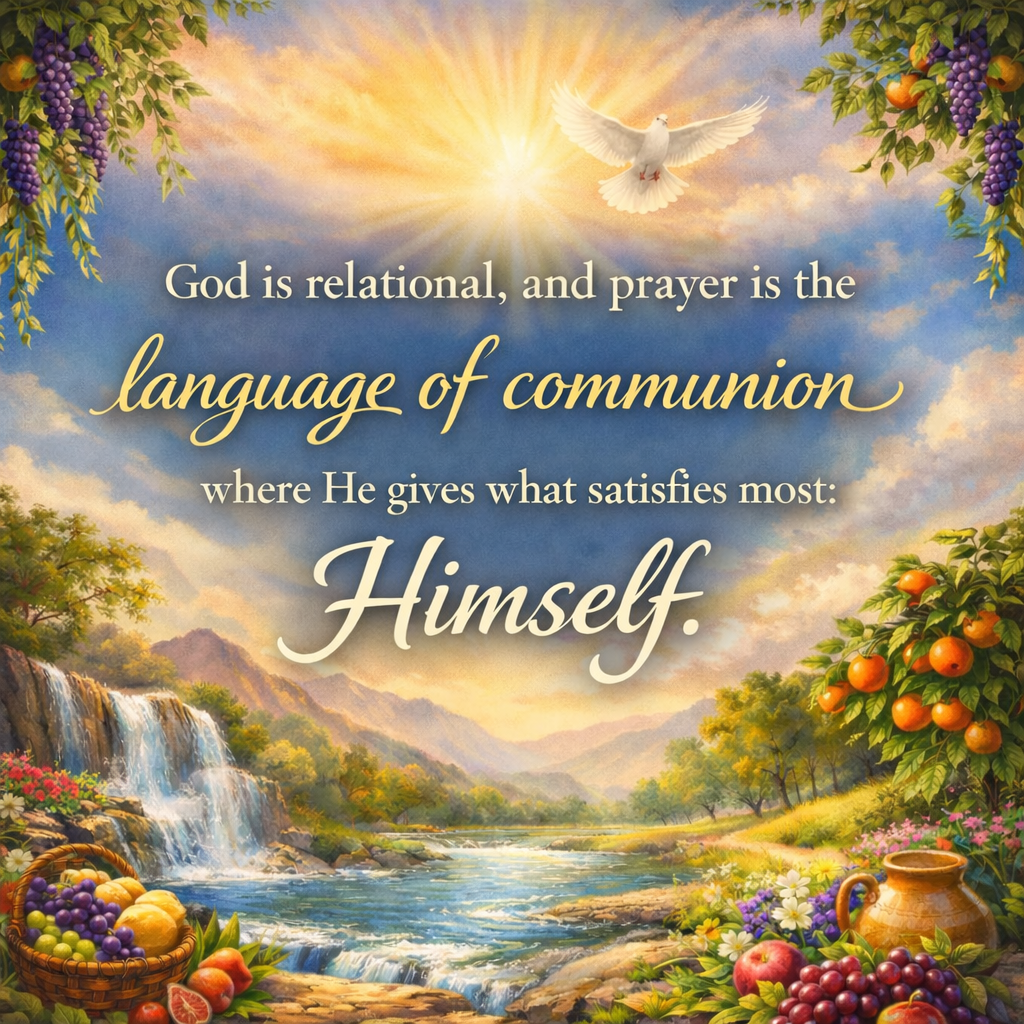
God does not only give things. He gives Himself. He gives His Spirit, which means His presence with His people, His help, His power, His guidance, His conviction, His comfort, and His strength to obey (John 14:16–17, 26). That is not secondary. It is central. If you have the Spirit, you have God near, not in theory but in reality.
This is where prayer starts to make more sense in seasons when motivation is weak. If prayer is mainly about getting a specific result, it will always be unstable. We will pray when we feel desperate, then drift when desperation fades or when outcomes do not come. But if prayer is communion with the Father who gives His Spirit, prayer remains meaningful even when circumstances move slowly. God is doing real work in the person praying. He is shaping desire, strengthening faith, exposing sin, giving patience, teaching endurance, and growing love.
Seek First
Matthew’s language about pursuing the kingdom fits here. Jesus says, “Seek first the kingdom of God and His righteousness, and all these things will be added to you” (Matthew 6:33). There is an order in that sentence. The kingdom comes first.
Jesus is not telling you to become spiritually impressive before God will pay attention to your life. He is showing you what kind of Father you have. Your needs are not invisible to Him. He sees the practical weight you carry: your body, your bills, your family pressure, and the things you are trying to hold together. He also knows what we often miss. Beneath all of that, our deepest need is a heart put back in the right order, with God in His rightful place, because that is where peace and obedience begin to grow.
When God gives the Spirit, He gives the help that enables you to seek the kingdom. He is not standing back, waiting for you to manufacture desire and discipline by sheer willpower. He comes near. He supplies what you lack (Romans 8:26). That is why the promise of the Spirit belongs in any serious conversation about prayer. God is not only hearing requests. He is giving Himself as the source from which desire for Him grows and obedience is sustained.
When we talk about recovering prayer, the question is not only, “How do I become more consistent?” A deeper question sits underneath it. Do I actually believe I am coming to a Father? Do I believe He gives what is good (Matthew 7:11)? Do I believe His most basic answer to prayer is Himself?
If those things become real, prayer stops feeling like a task we keep failing. It becomes a place we return to because the Father has told His children to come.
Discussion Questions
- When you struggle to pray, what is usually underneath it for you. Distraction, guilt, disappointment, numbness, or something else.
- Why do you think Jesus ends the Ask, Seek, Knock teaching with the promise of the Holy Spirit (Luke 11:13).
- In the Lord’s Prayer, which petition feels hardest to pray sincerely right now, and what does that tell you about where you feel resistance (Luke 11:2–4).


Leave a comment