
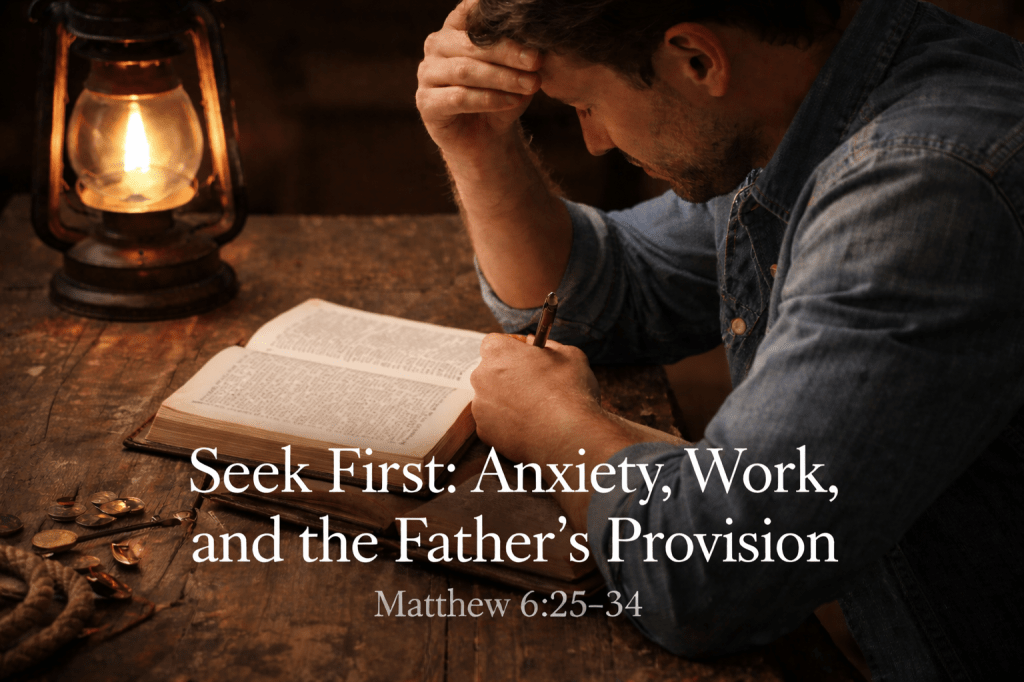

Seek First: Anxiety, Work, and the Father’s Provision
Matthew 6:25–34
Anchor verse: Matthew 6:33
In the Sermon on the Mount, Jesus tells His disciples not to be anxious, yet many of us still struggle to understand what that means for work, finances, and family. Bonhoeffer’s reading of Matthew 6 in The Cost of Discipleship helps clarify the issue. Anxiety grows when we confuse faithful labor with the burden of securing life itself.
Anxiety usually gathers around things that matter. Food matters. Bills matter. Work matters. Family matters. Jesus is not speaking about imaginary concerns, but ordinary human needs and the real pressures attached to them.
What He addresses is the way those pressures settle into the heart. Real responsibilities can be carried wrongly. Concern becomes a burden when we begin to live as though keeping life together rests on us.
Jesus does not tell His disciples their needs are unimportant. He tells them their Father already knows those needs (Matthew 6:32). Anxiety grows where that truth stops working deeply in us. We may still say that God provides, but inwardly live as though provision depends on our foresight, effort, and ability to keep tomorrow from falling apart.
Bonhoeffer writes, “Neither anxiety nor work can secure his daily bread, for bread is the gift of the Father.” That line makes a distinction many of us blur. Work is good. Responsibility is good. Scripture is clear about that. A man should work, take responsibility seriously, and be faithful with what God has given him to do.
But work and provision are not the same thing. Labor belongs to obedience. Provision remains in the Father’s hands. When those are collapsed into one thing, work starts to carry a weight it was never meant to carry. It becomes security. It becomes the means by which we try to hold life together.
Jesus points to the birds and the lilies to remind us how life actually works (Matthew 6:26–30). They are sustained by the care of God, and we are no different in that respect. Work, planning, income, and responsibility do not change the fact that we still depend on our Creator for what we need.
Bonhoeffer says that man in revolt imagines a direct relation of cause and effect between work and sustenance. That is easy to understand. We work, so we eat. We plan, so we feel safer. We produce, so we feel valued. There is a practical connection between labor and provision in daily life, and Scripture does not deny it. But Jesus is dealing with what the heart trusts. He is confronting the illusion that our labor secures our life.
That illusion is closely tied to anxiety. A man can work hard, care deeply, and plan responsibly while still believing that keeping life secure finally rests on him. That belief will wear him down. Stewardship begins to feel like self-reliance. Duty becomes a burden. Tomorrow starts to feel like something he has to carry before it comes.
Jesus addresses this directly: “Which of you by being anxious can add a single hour to his span of life?” (Matthew 6:27). Anxiety can feel productive because it keeps the mind occupied and makes us feel as though we are doing something. But it does not sustain life, protect life, or add to life.
“Your heavenly Father knows that you need them all” (Matthew 6:32). The disciple still works, plans, and carries real responsibility, but not as someone left on his own. All of it is lived before a Father who already knows what is needed and remains the one who provides.
Then Jesus says, “Seek first the kingdom of God and his righteousness, and all these things will be added to you” (Matthew 6:33).
He is speaking about what comes first in a person’s life. If the kingdom of God and His righteousness are not first, something else will take that place. Often it will be something tied to security: money, control, productivity, preparedness, or the need to manage outcomes. Even good responsibilities can begin to occupy that place. When they do, anxiety grows because we are leaning on things that were never meant to hold us up.
Seeking the kingdom first means ordinary concerns no longer rule the heart. They are placed under God, where they belong. Bonhoeffer says worldly cares are distinct and subordinate concerns. They matter, but they were never meant to hold the first place.
That changes how a man lives before God. He can work hard without looking to work as the thing that secures him. He can care for his family without believing their lives finally rest in his hands. He can make plans without forgetting that the future belongs to God. He can receive what is given with gratitude, knowing that daily bread still comes from the Father.
Luther says, in the passage Bonhoeffer quotes, that a man has a duty to work and do what is set before him, while knowing that it is another who nourishes him. That puts labor in its proper place. Work remains an act of obedience, and provision remains in God’s hands. When those are held together, a man can be diligent without being ruled by fear.
Jesus closes the passage by saying, “Do not be anxious about tomorrow, for tomorrow will be anxious for itself. Sufficient for the day is its own trouble” (Matthew 6:34). He speaks plainly about trouble, need, and pressure. Those things do not disappear. But tomorrow still belongs to God, and the call of the disciple is to trust Him and be faithful with what is in front of him today.
For many men, anxiety speaks in the language of responsibility. It can sound reasonable and necessary, and some of it grows out of a sincere desire to care well for others. But some of it comes from the deeper belief that we must hold together what only God can hold together. Matthew 6 brings that into the open. Jesus teaches His disciples to work, live, and pray as men who have a Father they trust.
A man should labor faithfully, but he should not treat his labor as the thing that sustains his life. He seeks the kingdom first, does the work set before him, and receives daily bread as a gift from his Father. Anxiety begins to loosen as the weight of ultimate provision is returned to the One who has promised to provide.
Discussion Questions
- Where do you most feel the pressure to hold life together right now, and how can you tell when responsibility has started to turn into anxiety?
- In your own life, what does it look like to work faithfully while still receiving provision as something that ultimately comes from God?
- What would it look like this week to seek the kingdom of God first in one area where you have been carrying fear, pressure, or the need to control outcomes?


Leave a comment