
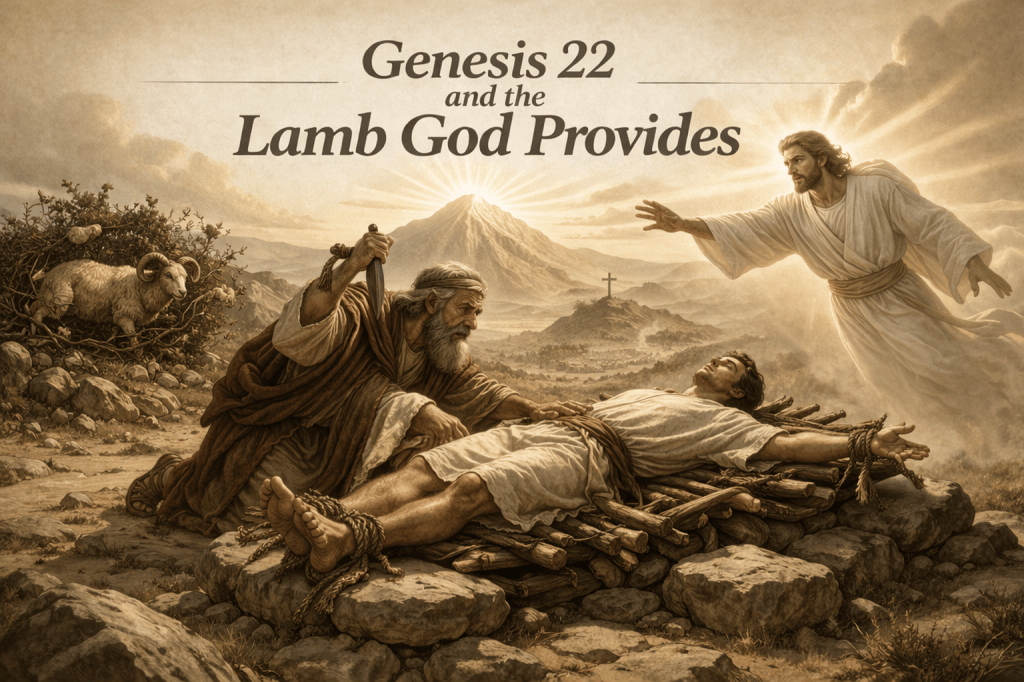

Roughly two thousand years before Christ went to the cross, Genesis 22 was already teaching God’s people how to think about sacrifice and substitution. Abraham’s obedience is part of the story, but the chapter reaches farther than that. It prepares us to recognize the Lamb God would one day provide.
God tells Abraham, “Take your son, your only son Isaac, whom you love.” The weight of the passage begins there. This is not a random offering. Isaac is the beloved son, the promised son, the son through whom the covenant line is meant to continue. Abraham is being asked to place the son of promise on the altar.
That is part of what gives the passage such force when read with Christ in view. At Jesus’ baptism and at the transfiguration, the Father identifies him as the beloved Son. The language is not identical, but the pattern is there. In both places, the son is central, and the cost is personal. Redemption is tied to the Son.
Isaac is not only loved. He is the one through whom God’s promise is supposed to come. That means Abraham is being asked to trust God beyond what he can make sense of. Hebrews tells us Abraham believed God could raise the dead. He did not understand the path in front of him, but he trusted the God who had spoken. That is real faith. It is one thing to trust God when obedience seems to confirm what you expected. It is another thing to trust him when obedience seems to put the promise itself at risk.
That speaks directly into the kind of confusion we have been looking at in Passion Week. The people in Jerusalem wanted a salvation they could recognize quickly. Abraham is brought to a place where his expectations cannot guide him. He has to trust the character of God.
The movement of Genesis 22 is deliberate. Abraham rises early, takes Isaac, and goes to the mountain God will show him. He is not improvising. He is walking in obedience toward the place of sacrifice. That is one of the clearest connections to the cross. Jesus is not swept into death by accident. He goes to Jerusalem knowingly. The Father is not reacting to events as though history has slipped out of his hands. The cross is the purpose of God being carried out in time.
Genesis 22 also tells us that Abraham laid the wood on Isaac, and Isaac carried it up the mountain. The son who is to be offered carries the wood of his own sacrifice. You do not have to force the comparison. The image is already there. It points naturally to Christ carrying the cross.
The passage also gives no sense that Isaac was dragged unwillingly. The text is restrained, but Isaac appears to yield. That is important because Christ does not simply suffer as one overpowered by men. He gives himself. His death is not merely inflicted on him. He lays down his life willingly. The sacrifice that saves is willingly given.
Then Isaac asks the question that hangs over the whole chapter: “Where is the lamb?” In one sense, he is asking about that immediate sacrifice. In another sense, the question reaches much farther than Abraham and Isaac. Where is the lamb God will accept. Where is the sacrifice that can truly deal with sin. Where is the offering that can bring the lost children back to God.
Abraham answers, “God will provide for himself the lamb.” In that moment, God provides a ram. The ram is enough for that mountain and that hour. Isaac walks down alive because another dies in his place. That is substitution in plain view. The son lives because a substitute is provided.
That is why Genesis 22 speaks so clearly to the cross. Jesus is not only an example of obedience or devotion. He is the substitute. He dies in the place of sinners. We stand before God because another has been offered for us. Isaac walked down the mountain because a substitute was provided. Sinners stand before God for the same reason.
Abraham names the place “The Lord will provide.” Jehovah Jireh. That name is important because Abraham does not name the place after his obedience. He names it after God’s provision. The mountain is remembered for what God gave.
That reaches straight into Passion Week. Jerusalem is not only the city where people welcomed a king, rejected him, and handed him over. It is the place where God provided the sacrifice himself. The Lord will provide. In Jerusalem, he did.
The final line of the chapter keeps reaching forward: “On the mount of the Lord it shall be provided.” That is more than a comment on Abraham’s life. It establishes something that runs through Scripture. God provides what his people cannot provide for themselves.
That is why the parallels are so strong. Isaac is the beloved son. Jesus is the beloved Son. Isaac is the son of promise. Jesus fulfills the promise. Isaac carries the wood. Christ carries the cross. Isaac asks, “Where is the lamb?” Christ is the answer. A ram dies so Isaac can live. Christ dies so sinners can live.
Then the difference brings the whole thing into focus. In Genesis 22, God stops Abraham from sacrificing Isaac. At Calvary, the Father does not spare his own Son. Abraham receives his son back. The Father gives his Son up. Isaac is spared by a substitute. Jesus is the substitute.
Genesis 22 teaches us to look for the lamb. Passion Week shows us that God has provided him.


Leave a reply to They Wanted a King. God Gave the Lamb. – Breakwater Blessings Cancel reply