
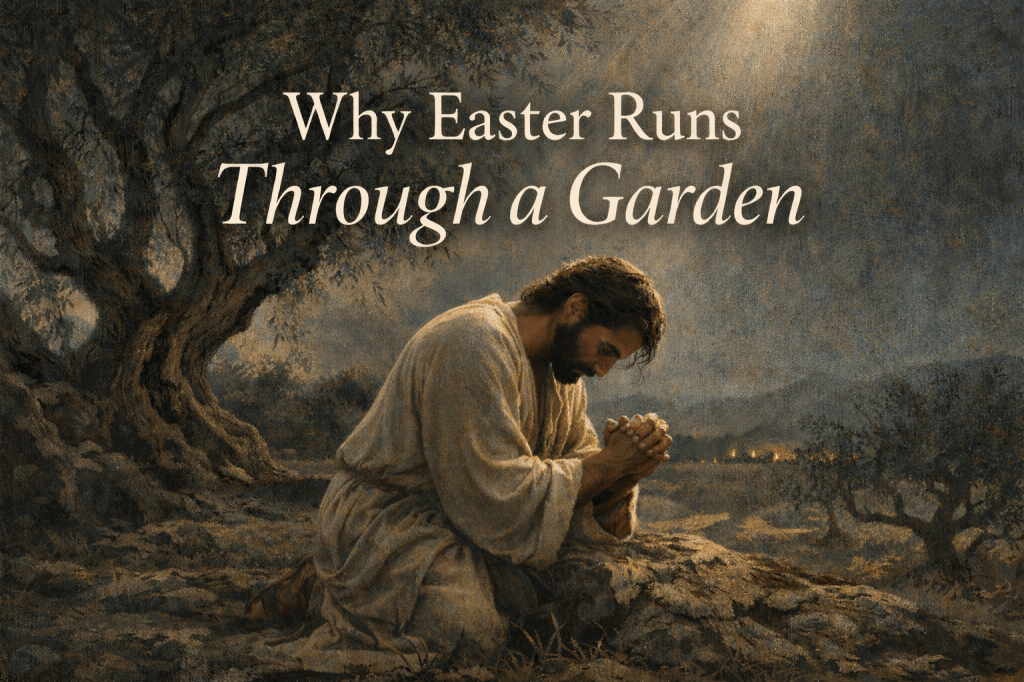

Easter is usually approached from the empty tomb. That is understandable, but the resurrection comes at the end of the story, not the beginning. Before Christ rose, he entered a garden and submitted himself to the will of the Father. Gethsemane is commonly understood to mean oil press or olive press. That detail fits the moment. There, Jesus comes under the weight of what obedience will require, and he does not turn away.
That garden is not incidental. The human story had already been broken in one before it.
In Eden, Adam lived under the good rule of God and chose his own will instead. Sin entered there, and death with it. So when Jesus enters Gethsemane on the night before the cross, we are seeing more than a man in anguish. We are seeing the Son stand where Adam failed. Adam turned from God. Christ remains under the Father’s will.
In Luke, we hear Jesus pray, “Father, if you are willing, remove this cup from me. Nevertheless, not my will, but yours, be done” (Luke 22:42, ESV).
That prayer belongs close to the center of Easter. Jesus is not being carried along by events outside his control. He knows what is before him. He knows what obedience will require. Still, he yields himself to the Father.
Paul names the meaning of this in Romans 5:19: “For as by the one man’s disobedience the many were made sinners, so by the one man’s obedience the many will be made righteous” (ESV). Adam’s disobedience brought ruin into the world. Christ comes as the second Adam and walks the road Adam refused. He lives and dies in obedience to the Father.
That obedience carries him to the cross. Jesus does not go there merely as a victim of human injustice, though he was unjustly condemned. He goes there as the obedient Son, bearing the sin and curse brought in by the first man. Galatians 3:13 says, “Christ redeemed us from the curse of the law by becoming a curse for us” (ESV). Gethsemane keeps this from becoming abstract. The cross was not an accident of history. The Son went there willingly in submission to the Father’s saving will.
That is why the victory of Easter cannot be separated from Christ’s obedience. We are drawn to Easter because the resurrection is triumphant, and rightly so.. But the triumph of Easter was carried through obedience. The Son entrusted himself fully to the Father, even unto death. Philippians 2:8 to 9 says that Christ “humbled himself by becoming obedient to the point of death, even death on a cross. Therefore God has highly exalted him” (ESV). The resurrection and exaltation are tied to the obedience that came before them.
That reaches into ordinary Christian life more deeply than we often admit. Most of us are willing to obey while the cost feels manageable. We prefer faithfulness with some control still in our hands. We want clarity, stability, and some assurance that obedience will preserve the life we were already trying to protect. Gethsemane brings us somewhere more searching than that. Christ entrusts himself to the Father with full knowledge of the suffering ahead.
Self will often appears in less obvious ways. It appears in the need to manage outcomes, the reluctance to depend on God, and the instinct to pull back when obedience starts taking something from us. Gethsemane shows how deep that struggle runs. It also shows what true strength before God looks like. Christ’s submission is active, deliberate, and full of trust.
So Easter runs through a garden because what happened there was not a tragic interruption of the plan. Christ’s submission to the Father was the plan. The Son willingly gave himself over to death to bear our penalty, deal with our sin, and reconcile us to the Father. He went to the cross in obedience and love so that those who trust in him would be brought into peace with God and kept in him forever.
The resurrection is the Father’s public vindication of the Son and the confirmation of the work he came to do. It declares that his offering was accepted, that death was defeated, and that reconciliation with God has truly been accomplished in him. Easter is the celebration of the risen Christ, who willingly went to death for us and now gives eternal life to all who trust in him. What he entered by obedience, we share by grace.
For as by the one man’s disobedience the many were made sinners, so by the one man’s obedience the many will be made righteous.
Romans 5:19 (ESV)
- Jesus prays, “Not my will, but yours, be done.” What usually stands in the way of praying that honestly, and what does that expose about our loves, fears, or need for control?
- Jesus knew what obedience would cost and still submitted himself to the Father. What does that show us about the difference between agreement with God and actual surrender to God?
- Where do you see the desire to preserve control competing with obedience in your own life, and why is that struggle often harder to recognize than open rebellion?
 Breakwater Blessings
Leave a comment