

The opening chapters of Genesis create real tension for a modern reader. The timeline feels unfamiliar, the ages feel extreme, and the whole setting presses against the categories most people use to think about science, history, and the development of human life. That tension is real, and there is no need to pretend otherwise. For many readers, the difficulty of reconciling early Genesis with modern ways of reading the world creates an immediate divide in the mind. The result is often that the text is either forced into a modern framework or quietly set aside before it has been allowed to say what it is saying.
That would be a loss. Whatever unresolved questions remain between science, history, and the early chapters of Scripture, those questions should not prevent careful attention to what Genesis is communicating about humanity, sin, mortality, and life before God. It may be that some parts of that reconciliation will remain beyond reach on this side of eternity. Even so, the unknown should not keep anyone from entering the text with patience and seriousness. For a little while, those modern questions can be held in suspension, not because they do not matter, but because Genesis is speaking in a way that needs to be heard on its own terms before it can be evaluated well.
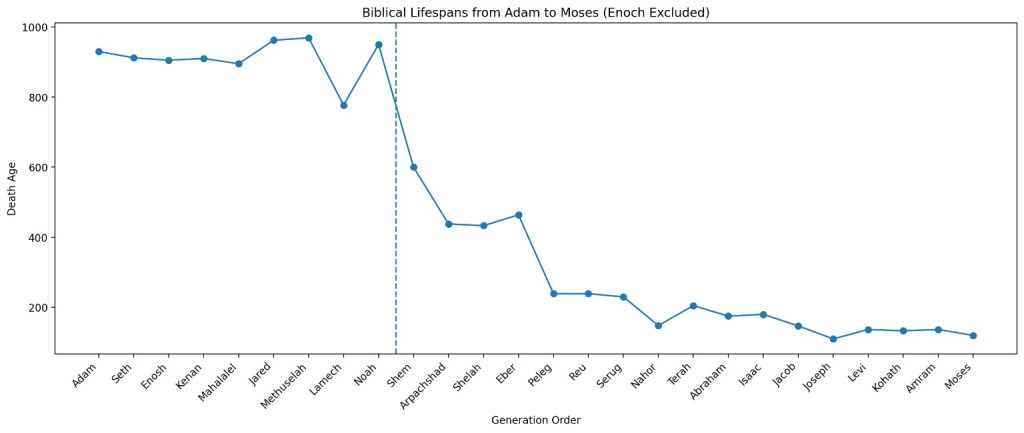
When the death ages from Adam to Moses are charted, excluding Enoch because he was taken by God and does not fit normal mortality, the pattern is stronger than it may first appear.
Before the flood, the numbers stay very high. After the flood, they drop hard and continue downward until Moses dies at 120.
The basic pattern
Pre-flood
- Adam: 930
- Seth: 912
- Enosh: 905
- Kenan: 910
- Mahalalel: 895
- Jared: 962
- Methuselah: 969
- Lamech: 777
- Noah: 950
Average: 912.2
Post-flood
- Shem: 600
- Arpachshad: 438
- Shelah: 433
- Eber: 464
- Peleg: 239
- Reu: 239
- Serug: 230
- Nahor: 148
- Terah: 205
- Abraham: 175
- Isaac: 180
- Jacob: 147
- Joseph: 110
- Levi: 137
- Kohath: 133
- Amram: 137
- Moses: 120
Average: 226.1
What stands out
A few things become clear pretty quickly.
- Before the flood, human life is presented on a scale far beyond ordinary experience.
- After the flood, that scale contracts sharply.
- The decline is not perfectly smooth, but the direction is clear.
- Moses dies at 120, which places him right at the number named in Genesis 6:3.
That last point is hard to ignore.
Genesis 6:3 and the limit on man
Genesis 6:3 says:
“Then the Lord said, ‘My Spirit shall not abide in man forever, for he is flesh: his days shall be 120 years.’”
Genesis 6:3 (ESV)
There are interpretive questions around that verse. Some take it as a countdown to the flood. Some take it as a limit on human lifespan. The genealogies make the second reading plausible, even if the limit is reached gradually rather than immediately.
People after the flood still live beyond 120 for a time. The number does not fall into place all at once. But the direction of the story moves toward that boundary. Human life narrows under divine decree.
What the numbers are doing
Genesis is not functioning like a modern biology chart. The numbers are part of the theology of the text.
They show a world moving farther from its original fullness.
They show the effect of sin and judgment pressing into human life across generations.
They show that death is not only a sentence spoken in Eden. It becomes an increasingly visible condition of life east of Eden.
The flood sits at the center of that movement. Before it, the ages remain elevated. After it, life contracts. That makes the flood more than a judgment event. It marks a change in the human condition as the story presents it.
Why the Moses connection is important
Moses dies at 120 in Deuteronomy 34:7.
That is significant because Moses is not a minor figure in the line. He is the great prophet of the old covenant, the mediator of the law, the one through whom Israel is led out of Egypt. Yet even he dies at the stated limit.
That tells us the problem has not been solved. Even the greatest servant under the old covenant remains under death.
Moses can lead the people out of slavery. He cannot lead humanity out of mortality.
Psalm 90 confirms the same reality
Psalm 90, the psalm of Moses, gives theological reflection on the same human condition:
“The years of our life are seventy, or even by reason of strength eighty; yet their span is but toil and trouble; they are soon gone, and we fly away.”
Psalm 90:10 (ESV)
By that point, the long patriarchal ages are gone. Human life is short, burdened, and passing. Psalm 90 does not treat that as a neutral fact. It places it before God.
- “You return man to dust” (Psalm 90:3)
- “We are brought to an end by your anger” (Psalm 90:7)
- “Teach us to number our days that we may get a heart of wisdom” (Psalm 90:12)
That fits the genealogy well. Genesis traces the narrowing of life through history. Psalm 90 interprets that narrowed life before God.
A simple reading of the pattern
Here is the clearest way to say it:
- Genesis begins with lifespans that give the early world unusual scale.
- The flood divides that world from the one that follows.
- Genesis 6:3 names a limit on man as flesh.
- The later genealogies move toward that limit.
- Moses dies at 120.
- Psalm 90 reflects on the shortened life of man as a creature under God.
Taken together, the decline in the ages reads less like a set of isolated numbers and more like a sustained theological claim. Human life is becoming more bounded, more fragile, and more clearly marked by mortality.
Why that matters for the larger biblical story
The Bible does not move toward a solution in the form of longer earthly lifespan. It moves toward resurrection.
That is an important distinction.
If the problem were simply that man does not live long enough, then more years would solve it. Scripture pushes deeper than that. The real problem is death itself, and death is tied to sin. The answer is not the recovery of ancient longevity. The answer is redemption and life in union with Christ.
That is why these genealogies are worth paying attention to. They are not there to satisfy curiosity. They locate the human story under judgment and prepare the reader to understand why man needs more than time.
Quick summary
| Observation | What it suggests |
|---|---|
| Pre-flood lifespans remain near 900 | The early world is presented with unusual magnitude |
| Post-flood lifespans drop sharply | The flood marks a real turning point |
| Genesis 6:3 sets 120 years | Human life is placed under a divine limit |
| Moses dies at 120 | The limit remains in force even for the great covenant mediator |
| Psalm 90 speaks of 70 to 80 years | Human brevity has become the ordinary condition |
Conclusion
The chart does not solve every question about the numbers, but it does make the pattern plain. Early in Genesis, human life is presented with a scale that feels close to the beginning of the world. After the flood, that scale contracts and continues downward until Moses dies at the very number named in Genesis 6:3. Psalm 90 then reflects on the world that has emerged, where life is brief, burdened, and dependent on God.
That movement fits the theology of Scripture. Sin does not remain an abstraction. It works itself into the conditions of human existence. The genealogies make that visible. They show life narrowing under judgment and mortality becoming the common human condition. By the time the line reaches Moses, the reader is left with the same conclusion the rest of Scripture presses forward. Man does not need more years as much as he needs deliverance from death itself.
 Breakwater Blessings
Leave a comment