

This article is not trying to prove the flood account, force science to endorse the biblical timeline, or smooth over every difficulty. Its goal is narrower. It is asking whether one common objection is actually as conclusive as people often claim.
One of the easiest ways to dismiss the flood account is to say the earth could never have been repopulated from eight people. To many modern readers that sounds like a scientific impossibility. The number feels too small, the timeline feels too short, and the genetics sound disastrous. If that objection were airtight, it would matter. But it is not airtight. The word impossible is often doing more work than the evidence can actually support.
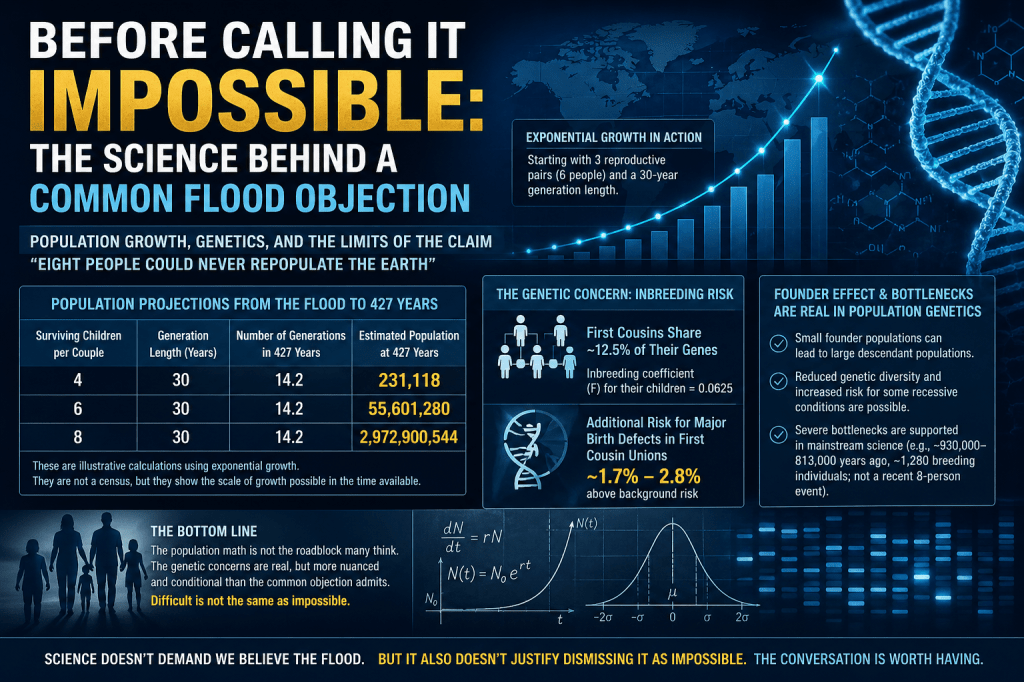
Start with the population math. Small founding populations do not grow in a straight line. They grow by compounding. Human population genetics literature has long recognized episodes of explosive growth. In a 2012 Science paper, Alon Keinan and Andrew Clark wrote that human populations had expanded by at least three orders of magnitude over roughly the past 400 generations. That does not prove the Genesis account, but it does show that the basic idea of small numbers becoming very large over time is not scientifically strange.
If you apply a simple growth model to the Genesis timeline, the numbers get large faster than most people expect. Begin with the three reproductive pairs implied by Noah’s sons and their wives. Assume a 30 year generation length. Then test a range of surviving children per couple. On a restrained model of four surviving children per couple, the population at 427 years comes out to about 231,118. At six surviving children per couple, it rises to about 55.6 million. At eight surviving children per couple, it reaches about 2.97 billion. Those figures are not a census. They are simply illustrative calculations showing the scale of exponential growth under the time available.
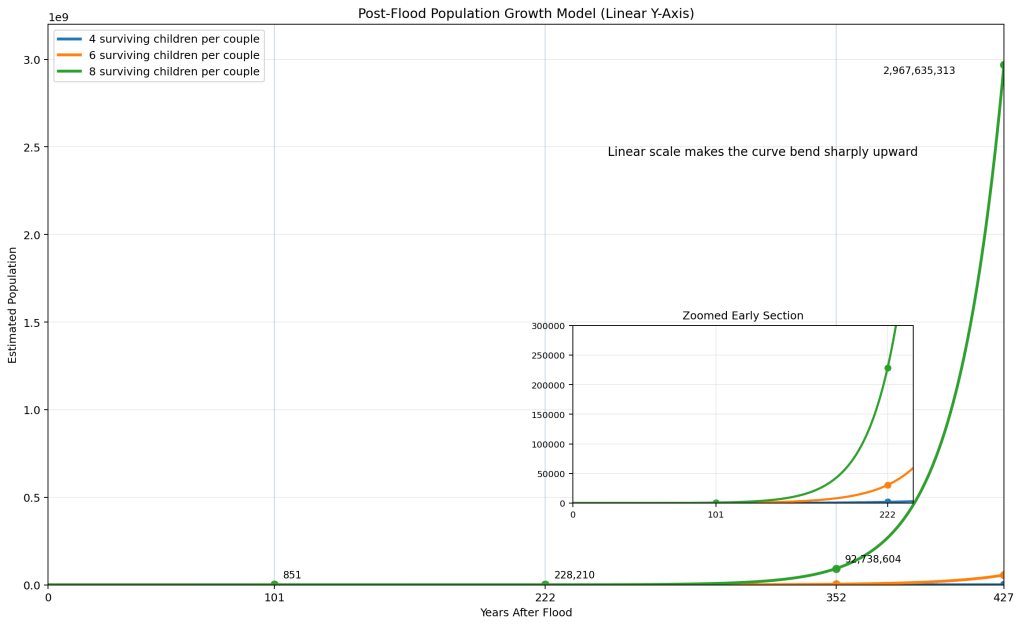
That matters because it weakens one of the most common claims people make about the story. Even the low estimate gets you into a substantial population. The middle estimate gets you into the tens of millions. The aggressive estimate becomes enormous. That does not tell us what the actual post-flood population was. It does show that the claim that eight people could not possibly lead to a large human population in the available time is mathematically weak.
The real pressure point is not the math. It is genetics.
This is where many objections become much more confident. People hear “one family,” think “inbreeding,” and assume immediate genetic collapse. There is a real scientific issue here, but it is often simplified beyond recognition. In genetics, the concern with close-relative unions is not that they are automatically catastrophic. The concern is that they increase the chance that harmful recessive variants already present in a family line will pair up in children. Standard consanguinity literature describes first cousins as sharing about 12.5 percent of their genes, and the inbreeding coefficient for their children is 0.0625. That is a measurable increase in genetic similarity, but it is not the same thing as guaranteed collapse.
The actual risk figures are also lower than many people assume. A 2021 genetics counseling review states that, in couples with no known genetic disorders in the family, first-cousin unions carry an additional 1.7 to 2.8 percent risk for significant birth defects above background population risk. That increase is real and should not be minimized. But it is not the same thing as inevitable deformity or near-certain biological failure. In other words, the science does not support the cartoon version of the objection.
That distinction matters because the danger depends heavily on mutation load. In plain language, it depends on how many harmful recessive variants are already present in the founding population. The more damaging recessive variants a population carries, the more dangerous close intermarriage becomes. Keinan and Clark’s paper is relevant here as well because rapid population growth tends to leave populations carrying many rare variants, including deleterious ones, since growth can outpace the ability of selection to remove them quickly. That means it is not scientifically careful to assume that a hypothetical founding population must begin with the same burden of rare harmful variants seen in modern populations.
Population genetics also does not treat founder populations or bottlenecks as biologically incoherent. Quite the opposite. The National Human Genome Research Institute defines the founder effect as a reduction in genetic variation that occurs when a small subset of a larger population establishes a new colony. Small founder groups can produce large descendant populations, though often with reduced diversity and elevated risk for some recessive conditions, especially if the group remains small and isolated. That is part of mainstream genetics, not fringe speculation.
Scientific honesty also requires saying what this argument does not establish. It does not show that mainstream human population genomics currently supports a recent bottleneck to eight people. It does not. A 2023 Science paper by Wangjie Hu and colleagues inferred a severe bottleneck in human ancestry, but placed it between about 930,000 and 813,000 years ago and estimated about 1,280 breeding individuals, not a recent reduction to one family after a flood. That study matters here for two reasons. It shows that severe bottlenecks are part of mainstream scientific discussion, and it shows that current mainstream genetics does not simply map onto the biblical timeline.
That keeps the argument honest. The claim here is not that the biblical account has been scientifically proven. The claim is that a common dismissal is often overstated. The population math is not the problem many imagine. The genetic issue is real, but it is more nuanced and more conditional than the shorthand objection usually admits. A person does not have to turn off reason, embrace pseudo science, or manufacture certainty to reject the lazy claim that this account is scientifically impossible on its face.
That may not prove the account. It does remove one common excuse for refusing to think about it carefully.
If someone has already decided that these stories belong in the same category as fairy tales from primitive people, that decision should rest on better grounds than a simplistic use of population math and a caricature of genetics. At the very least, these issues deserve to be described accurately. Once that false sense of impossibility is weakened, the discussion can move forward in a better way, with seriousness, openness, and a willingness to examine the text without dismissing it before the work has even begun.
References
Keinan, A., and Clark, A. G. “Recent Explosive Human Population Growth Has Resulted in an Excess of Rare Genetic Variants.” Science 336, no. 6082 (2012).
Bittles, A. H., and Black, M. L. “Consanguinity, Human Evolution, and Complex Diseases.” Proceedings of the National Academy of Sciences 107 Suppl 1 (2010).
Bennett, R. L., Motulsky, A. G., Bittles, A., et al. “Genetic Counseling and Screening of Consanguineous Couples and Their Offspring.” Journal of Genetic Counseling 30 (2021).
National Human Genome Research Institute. “Founder Effect.” Genetics Glossary.
Hu, W., et al. “Genomic Inference of a Severe Human Bottleneck During the Early to Middle Pleistocene Transition.” Science 381, no. 6661 (2023).
Illustrative population model used in this article: 427 years, 30 year generations, 3 starting reproductive pairs, and 4, 6, or 8 surviving children per couple.
 Breakwater Blessings
Leave a comment