
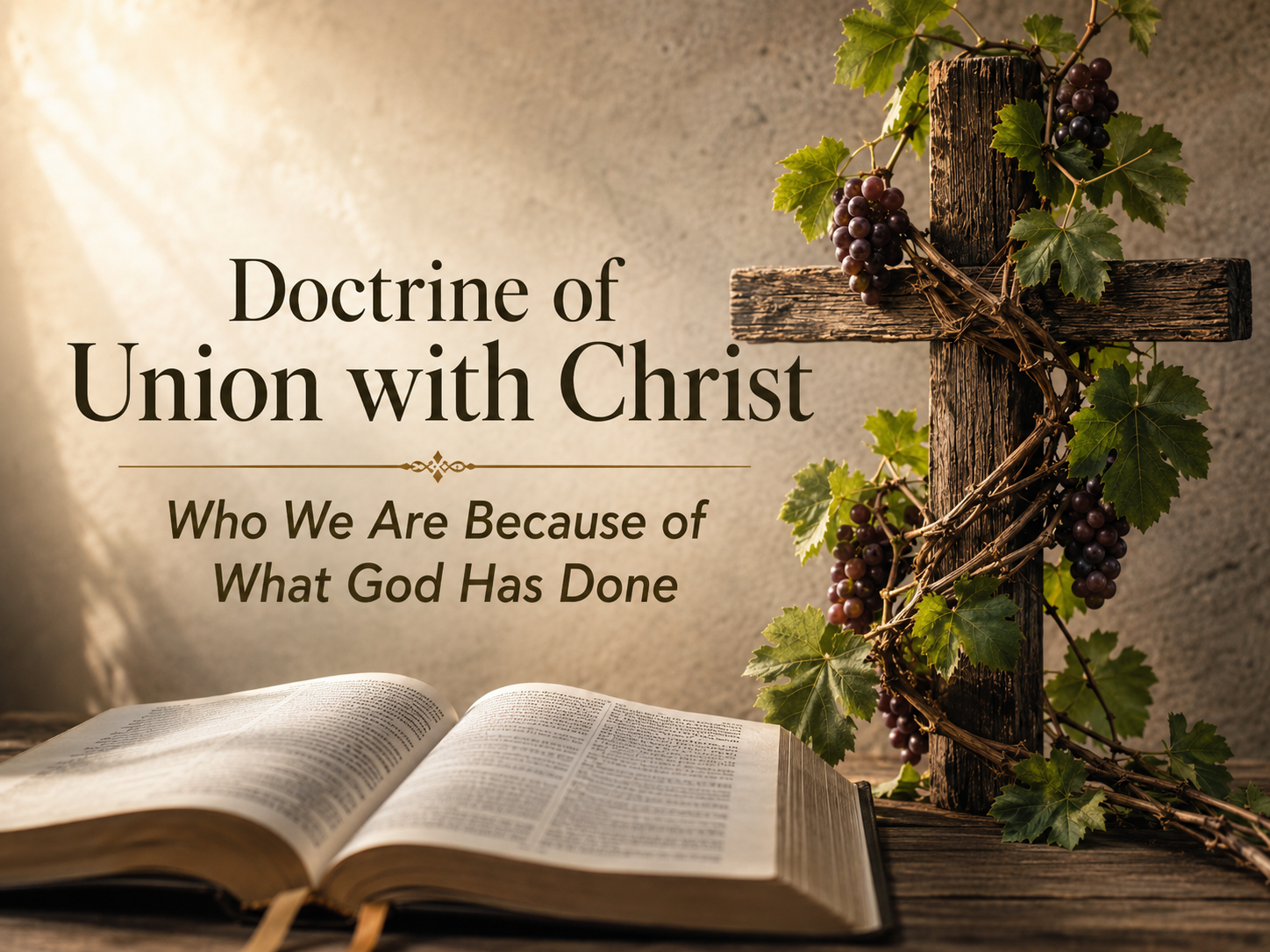

Chosen and Loved in Christ
Week 1 of In Christ: Who We Are Because of What God Has Done
Main passage: Ephesians 1:3-14
Anchor verse: Ephesians 1:4-5
“He chose us in him before the foundation of the world, that we should be holy and blameless before him. In love he predestined us for adoption to himself as sons through Jesus Christ.”
Ephesians 1:4-5
Anchor quote:
“Thou hast formed us for Thyself, and our hearts are restless till they find rest in Thee.”
Augustine, Confessions
Many people spend their lives trying to answer a basic question: “Who am I?”
Some look for that answer in achievement. Some look for it in family, career, reputation, usefulness, appearance, intelligence, personality, pain, failure, or the approval of other people. Christians can do this too. We can believe in Christ and still live as though our deepest identity is being decided each day by how well we perform, how others respond to us, how strong we feel, or how badly we failed.
That way of living is exhausting because those things were never meant to carry the weight of the soul. Success fades. Approval shifts. Failure lingers. Emotions rise and fall. Other people may love us, misunderstand us, need us, reject us, or praise us, but none of them can finally tell us who we are before God.
Augustine understood that restlessness. We were made for God, and the heart cannot finally rest until it rests in him.
Detailed Study – Why do good things still leave us unsatisfied? – Breakwater Blessings
Ephesians 1 begins with that kind of rest. Paul does not begin with what the Christian must achieve. He begins with what God has done. Before he gives commands, he gives worship. Before he talks about the Christian walk, he talks about the grace of God in Christ.
Paul says God “chose us in him.” That phrase matters. God did not choose us because he saw strength in us. He did not choose us because we would become impressive. He did not choose us because we had made ourselves worthy. He chose us in Christ.
That means the foundation of Christian identity is not the self. It is not our discipline, background, sincerity, usefulness, or record. It is God’s grace given to us in Jesus Christ.
Paul piles up the language of grace. The believer is blessed in Christ, chosen in Christ, adopted through Christ, redeemed through his blood, forgiven according to the riches of God’s grace, given an inheritance, and sealed with the Holy Spirit. These are not small religious encouragements. They are the deepest truths about everyone who belongs to Jesus.
The Christian life begins with receiving what God says is true.
That can be hard because we are used to identities that have to be defended. If my identity is built on achievement, I have to keep achieving. If it is built on approval, I have to keep managing how people see me. If it is built on being needed, I have to keep making myself necessary. If it is built on failure, I may keep punishing myself because I do not know who I would be without shame.
Paul gives us something better. The believer was chosen in Christ and adopted through Christ. God gives us an identity that does not begin with our performance and does not collapse under our weakness.
This does not make obedience unimportant. Paul says God chose us “that we should be holy and blameless before him.” Grace does not leave us unchanged. God saves sinners and then forms them into a holy people. But holiness is not the price we pay to become loved. Holiness is the life God is producing in those he has already loved in Christ.
That order matters.
If we reverse it, Christianity becomes another anxious attempt to secure ourselves. We try to obey so God will want us. We try to improve so God will keep us. We try to become useful so God will value us. That is not the gospel Paul is praising in Ephesians 1. God acts first. God loves first. God chooses, adopts, redeems, forgives, and seals his people in Christ.
The believer obeys from that place, not toward it.
Adoption is especially important here. Forgiveness removes guilt, but adoption gives belonging. God does not merely cancel the debt and leave us standing outside the house. He brings us in. He gives us a name, a place, and a future.
That speaks directly to the restlessness Augustine described. The heart keeps asking achievement, relationships, success, pleasure, control, and reputation to give it rest. They cannot do it. They were never meant to do it. The soul can only rest when it knows it belongs to God.
Identity in Christ is not a religious way of saying, “Feel better about yourself.” It is much deeper than that. It tells us what God has actually done. The Christian can say, “Before I had anything to offer, God set his love on me in Christ. Before I could prove myself, he chose me in Christ. Before I could make myself acceptable, he adopted me through Christ. Before I could secure my future, he sealed me with the Holy Spirit.”
That does not make the Christian proud. It humbles him. There is no room for boasting when everything rests on grace. The right response is worship.
This also changes how we handle weakness and failure. A Christian can confess sin honestly because sin is not his deepest identity anymore. He can repent without despair because his hope is not in his own record. He can grow without pretending because God’s grace is not fragile. He can face criticism without being destroyed by it and receive encouragement without needing to live on it.
That kind of stability does not come from self-confidence. It comes from being rooted in Christ.
Ephesians 1 teaches us to begin where God begins. Not with our fears. Not with our failures. Not with our usefulness. Not with our need to be seen or approved. God begins with grace in Christ.
The question is whether we will allow God’s word to define us more deeply than the voices we usually listen to.
Some of those voices come from family, culture, work, friends, enemies, or social media. Others come from memory, shame, pride, insecurity, ambition, regret, or fear. Some flatter us. Some accuse us. Some pressure us. Some tell us we are nothing unless we prove ourselves again today.
Ephesians 1 speaks a stronger word.
If you belong to Christ, you are not an accident. You are not the sum of your failures. You are not held together by your usefulness. You are not earning your way into the Father’s house. God has blessed you, chosen you, adopted you, redeemed you, forgiven you, and sealed you in Christ.
That is where Christian identity begins.
Not in the restless search to become enough, but in the grace of God that has already come to us in Jesus Christ.
Main idea
Our identity begins with God’s grace, not our performance. Before the believer obeys, serves, grows, or bears fruit, he has already been chosen and loved in Christ.
False identities this confronts
We are not defined by achievement.
We are not defined by failure.
We are not defined by approval.
We are not defined by usefulness.
We are not defined by our past.
We are not defined by our ability to hold ourselves together.
The believer’s life is defined by God’s grace in Christ.
Closing thought
The Christian life does not begin with the command to become someone God could love. It begins with the grace of God in Christ. He has chosen, adopted, redeemed, forgiven, and sealed his people. We spend the rest of our lives learning to accept and live from what he has already made true.
Small group discussion questions
- Why does it matter that Paul says we are chosen “in him”?
- How does adoption say something more than forgiveness alone?
- What false identity do you most often drift back toward?
- Why should being chosen and loved in Christ lead to humility rather than pride?
- What would change if you believed more deeply that God’s grace came before your performance?
 Breakwater Blessings
Leave a comment