
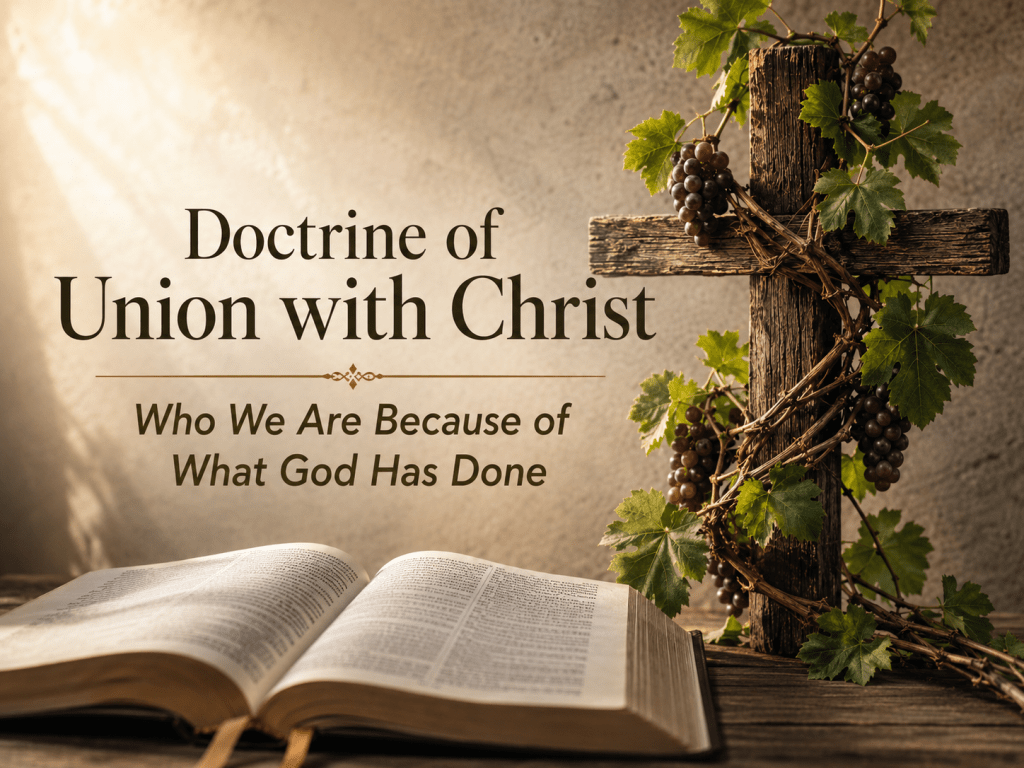

Week 2 of Doctrine of Union with Christ: Who We Are Because of What God Has Done
Main passage: Romans 6:1-14
Anchor verse: Romans 6:5
“For if we have been united with him in a death like his, we shall certainly be united with him in a resurrection like his.”
Romans 6:5
Anchor quote:
“The determining factor of my existence is no longer my past. It is Christ’s past.”
Sinclair Ferguson
Many Christians think about salvation mainly in terms of forgiveness. That is true and necessary. We have sinned against God. We need guilt removed, mercy given, and the blood of Christ to cleanse us.
But Scripture says more.
The believer is not only forgiven by Christ. He is united to Christ.
Romans 6 brings this truth forward with unusual force. Paul is answering a serious question. If salvation is by grace, should we continue in sin so that grace may increase? His answer is immediate: “By no means!” Then he explains why. The Christian has died to sin because he has been joined to Christ in his death.
That is deeper than “try harder.” Paul does not treat sin as a small behavior problem. Sin is a power that once ruled over us. It shaped our desires, claimed our obedience, distorted our loves, and held us under its authority. But when Christ died, he died to sin once for all. When we were united to Christ, his death became ours.
The old rule has been broken.
That does not mean the Christian no longer struggles. Romans 6 does not pretend temptation disappears. A believer may still feel the pull of old desires, fight old patterns, and grieve real failure. But he must not speak as though sin still owns him.
Sin remains an enemy, but it is no longer the believer’s master. A man in Christ should not excuse sin, protect it, rename it, or surrender to it. He also should not despair when he sees the fight clearly. The presence of struggle does not mean the old master still owns the house. It means the believer must learn to live under the Lord who has already claimed him.
Sinclair Ferguson captures this well: “The determining factor of my existence is no longer my past. It is Christ’s past.” Most of us know what it is like to feel governed by our history. We remember what we have done, what was done to us, and the patterns of failure, shame, anger, lust, fear, pride, and compromise that seem to follow us. Those things can begin to feel like a settled identity.
Romans 6 says they are not.
The deepest fact about the Christian is not what happened in his past. The deepest fact is what happened to Christ, and what happened to him because he is united to Christ. Christ died, and the believer died with him. Christ was raised, and the believer now walks in newness of life.
This is not positive thinking. It is not pretending the past did not happen or denying the damage sin has done. Paul is telling us to understand our past in light of a greater reality. If you are in Christ, your old life no longer has final authority over you.
Paul uses baptism to make this visible. Baptism shows that the believer has been buried with Christ and raised with him. It points to union with Christ. It says the Christian has passed from one realm to another, from Adam to Christ, from death to life, from slavery to freedom.
That is why Paul tells believers to “consider” themselves dead to sin and alive to God in Christ Jesus. He is not telling them to imagine something false. He is telling them to count as true what God says is true.
Many Christians wait to feel dead to sin before they believe they are dead to sin. They wait to feel new before they believe they have been raised with Christ. They let temptation, emotion, and recent failure interpret reality for them. Paul moves the other way. He tells believers to let Christ interpret their lives.
That does not make the fight against sin passive. Paul says, because you are united to Christ, do not let sin reign in your mortal body. Do not present yourself to sin as an instrument for unrighteousness. Present yourself to God as someone brought from death to life.
Grace does not make peace with sin. Grace breaks sin’s claim and teaches us to live under a new Lord.
We do not obey in order to escape the old master. In Christ, the old master’s rule has already been broken. We obey because we now belong to God. We offer our minds, bodies, desires, words, habits, and choices to the One who brought us from death to life.
That gives real hope to the believer who feels stuck. If change depended only on discipline, the past would probably win. If freedom depended only on resolve, sin would remain stronger than us. But Paul grounds our hope in Christ’s death and resurrection.
The believer can fight sin because Christ has already broken sin’s dominion.
Union with Christ also gives humility. We did not free ourselves. We did not crucify the old self by our own power. We did not raise ourselves into new life. Salvation is from beginning to end the work of God in Christ. Even our obedience is the fruit of grace.
Paul ends with a simple and powerful statement: “Sin will have no dominion over you, since you are not under law but under grace.”
That is the truth Romans 6 gives us. The believer is not merely trying to become free. He has been united to the crucified and risen Christ. He has been brought from death to life. He now belongs to God.
The Christian life changes as we learn to believe what God says in Romans 6 more than we believe our shame, our temptations, or our recent failures.
If you are in Christ, your past is real, but it is not lord.
Christ is Lord.
And you are united to him.
Main idea
The Christian is not only forgiven by Christ, but united to Christ. His death becomes our death, his resurrection becomes our new life, and sin no longer has rightful authority over us.
False identities this confronts
We are not slaves to sin.
We are not defined by our past.
We are not trapped in the old self.
We are not powerless before temptation.
We are not merely trying to improve the old life.
The believer has been united to Christ and brought from death to life.
Closing thought
Christ does not save his people from a distance. He joins them to himself. His death breaks sin’s dominion. His resurrection opens the way into new life. The believer does not fight sin in order to become united to Christ. He fights as a response to unity because, by grace, he already belongs to the crucified and risen Lord.
Small group discussion questions
- Why do many Christians think of salvation mainly as forgiveness, and why is that not the whole picture?
- What is the difference between saying “sin is still a real enemy” and saying “sin is still my master”?
- Where are you most tempted to treat your past as the deepest truth about you?
- What does it mean to “consider” yourself dead to sin and alive to God in Christ Jesus?
- What would change if you believed more deeply that sin no longer has rightful authority over you?
 Breakwater Blessings
Leave a comment