
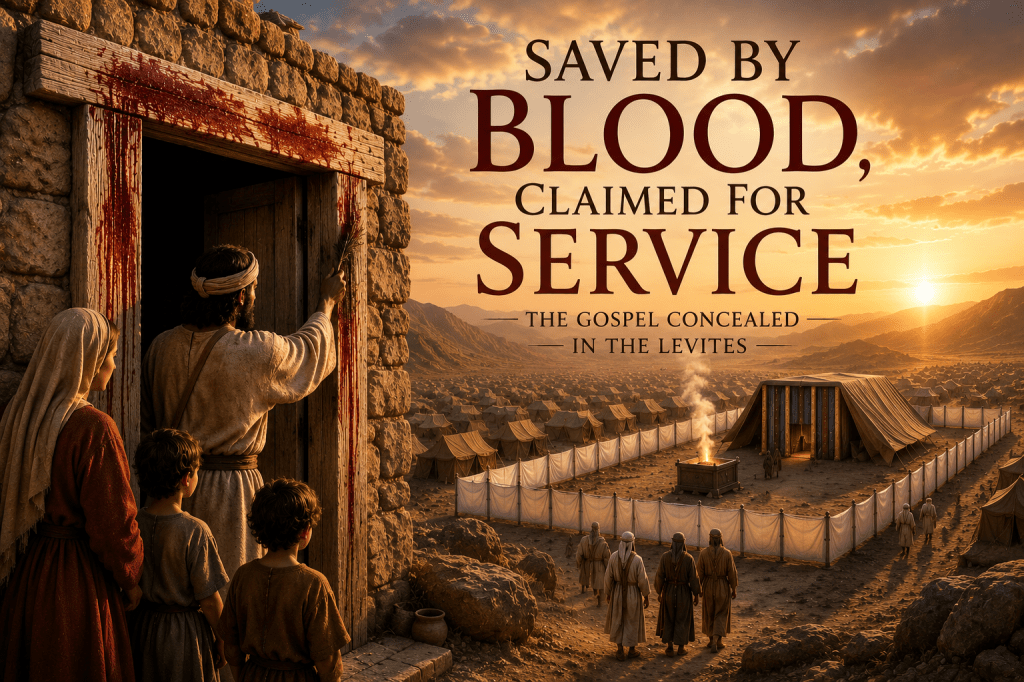

How many firstborn Israelites were saved by the blood of the lamb?
Exodus does not give us an exact number from the night of Passover. It tells us that judgment fell on Egypt, and it tells us that Israel was spared under the blood. The Lord had warned that every firstborn in the land of Egypt would die, from Pharaoh’s house to the lowest servant, even to the firstborn of the livestock. But to Israel He gave a promise: “When I see the blood, I will pass over you” (Exodus 12:13).
The firstborn lived because a lamb had died.
But the story of Passover did not end in Egypt.
The blood on the doorposts was not only the difference between death and life for one night. It also marked the beginning of a claim. The firstborn who were spared did not simply walk away from judgment and return to ordinary life. They belonged to the Lord.
That is why, after the exodus, God said, “Consecrate to me all the firstborn” (Exodus 13:2). The spared firstborn were not merely survivors. They were redeemed lives. Mercy had placed a claim on them.
Numbers 3 shows how that claim would be worked out among the people of Israel.
The Lord commanded Moses to count every firstborn male among the Israelites, one month old and older. The number was 22,273 (Numbers 3:43). This should not be treated as an exact count of how many firstborn Israelites were alive on Passover night. It is a later count in the wilderness. But it is the number Scripture gives when God explains what the Passover meant for Israel’s firstborn.
They had been saved by blood. Now they were claimed by God.
Then God did something unexpected. Instead of requiring every firstborn son in Israel to serve directly in the tabernacle, He took the Levites in their place. “Behold, I have taken the Levites from among the people of Israel instead of every firstborn” (Numbers 3:12). The Levites would belong to the Lord in a special way, standing in the place of the firstborn who had been spared.
The Levites were not merely a replacement number in a census. They were a tribe set apart for life near the presence of God. The priesthood itself belonged specifically to Aaron and his sons, but the tribe of Levi was given for holy service connected to the tabernacle, its worship, and its sacred responsibilities. They carried, guarded, served, and lived in relation to the place where God dwelt among His people.
That is important. The firstborn were represented by a people brought near to God for service. Redemption did not lead to independence. It led to consecration.
But there was another detail in the count.
There were 22,273 firstborn males in Israel and 22,000 Levites counted in their place. That left 273 firstborn males who were not covered by the Levitical substitution.
God did not overlook the remainder.
For those 273, a redemption price had to be paid: five shekels each, for a total of 1,365 shekels (Numbers 3:46–51).
The 273 matter because God did not treat them as a rounding error. These were not loose numbers in a census. They represented real firstborn sons, real households, real lives that belonged to Him. If they were not represented by the Levites, they had to be redeemed by price.
Saved by blood, claimed by God, redeemed by price, set apart for service — this is the pattern concealed in Numbers 3 and revealed in Christ.
The Old Testament does not give us the gospel in its full brightness all at once. It gives us promise, shadow, pattern, sacrifice, priesthood, blood, substitution, and redemption. The shape of gospel grace was already there, though not yet revealed in its fullness.
The Passover lamb pointed forward. The consecrated firstborn pointed forward. The Levites standing in the place of the firstborn pointed forward. Even the 273 and their redemption payment pointed forward.
But none of these could finally accomplish what they pictured.
The blood of lambs could mark the doors of Israel for one night, but it could not cleanse the conscience. The Levites could stand in the place of the firstborn for tabernacle service, but they could not stand in the place of sinners before the final judgment. Silver could redeem the firstborn ceremonially, but it could not pay the true cost of salvation.
That greater redemption required a greater price.
In Christ, the concealed pattern is revealed. He is the true Passover Lamb whose blood saves from judgment. He is also the true Firstborn, not because He is created, but because He is preeminent, the heir over all things, and the firstborn from the dead. The firstborn of Israel were spared from death. Christ entered death and rose beyond it, bringing His people with Him.
He is the Firstborn who does not need redemption, yet gives Himself to redeem others.
Peter says we were ransomed “not with perishable things such as silver or gold,” but “with the precious blood of Christ” (1 Peter 1:18–19). The price was not five shekels. It was not 1,365 shekels. It was not anything that could be weighed, counted, or stored in a treasury.
The price was His blood.
This is where Ephesians 2 helps us see the pattern clearly. Paul writes that we are saved by grace through faith, and this is not our own doing. It is the gift of God, “not a result of works, so that no one may boast” (Ephesians 2:8–9). Salvation is not purchased by our service. We are not redeemed because we have made ourselves useful to God.
But Paul does not stop there. “For we are his workmanship, created in Christ Jesus for good works, which God prepared beforehand, that we should walk in them” (Ephesians 2:10).
That is the order of grace.
Good works do not purchase salvation. Service does not earn redemption. But grace does not leave the redeemed to themselves. Those saved by grace are brought near to God and given a life of worship, obedience, and service.
The Levites help us see this pattern in shadow. They were taken by God, brought near to His presence, and set apart for service. Their service did not create redemption. It flowed from God’s claim. In Christ, that pattern becomes clearer and deeper. Those saved by grace are not left to belong to themselves. They are made God’s workmanship.
The Passover did not end in Egypt because redemption never ends with escape. The blood that spared the firstborn also marked them as belonging to God. The Levites showed that the redeemed life is a consecrated life. The 273 showed that redemption requires a price.
In Christ, that price has been paid in full. The Lamb has come. The true Firstborn has passed through death and risen in victory. And those saved by grace now belong to God, not because their service purchased redemption, but because redemption has brought them near.
 Breakwater Blessings
Leave a comment