Breakwater Blessings – Where chaos yields to Christ

Trust in Christ: An Invitation to New Life

  • Apologetics (6)
  • Bible & Theology (12)
  • Christian Living (43)
    • Men's Group (5)
    • Relationships (20)
    • Spiritual Growth (15)
  • Church History & Myths (4)

Return Home

Don’t feel capable of sharing your faith? You are called to share, not convince.

Apologetics, Christian Living, Spiritual Growth
Jay Downes's avatar

Jay Downes


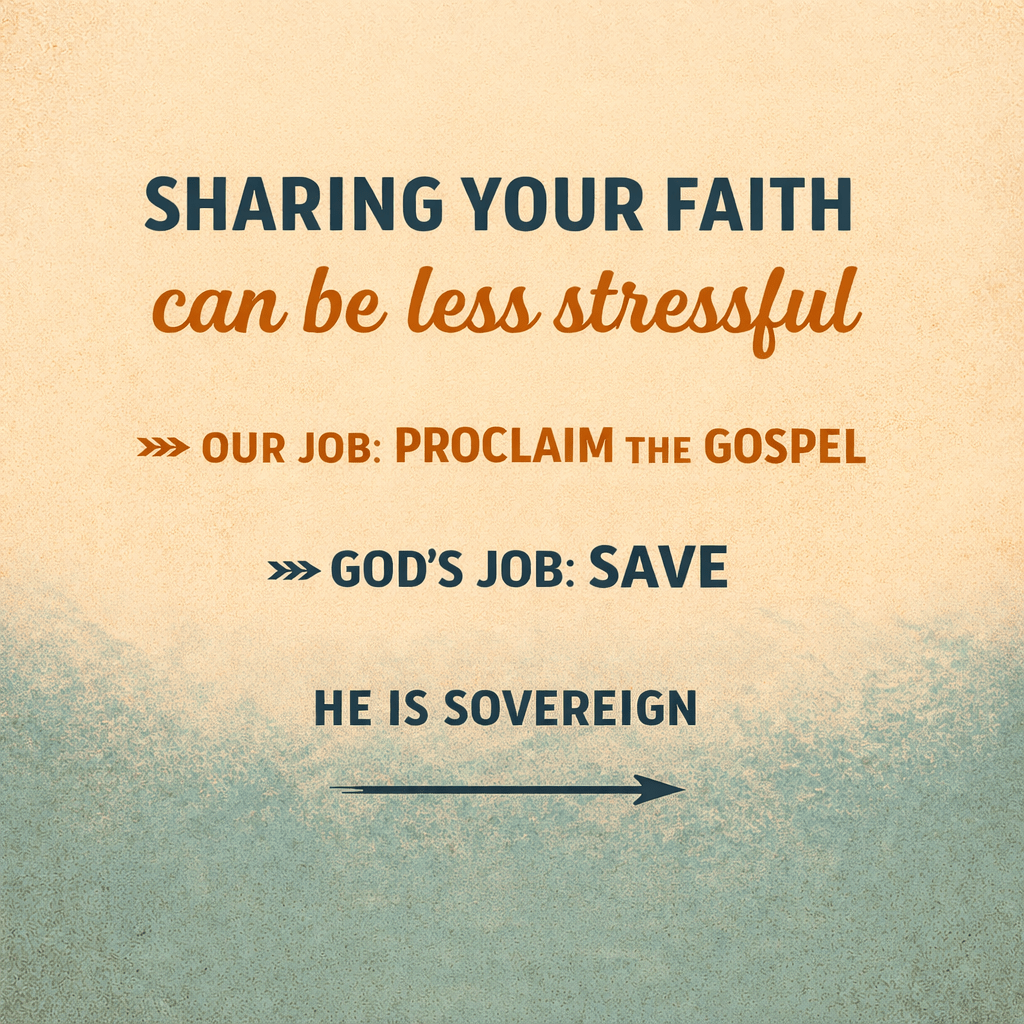
Most Christians do not stay silent about the gospel because they are ashamed of Christ. They stay silent because they feel the weight of getting it wrong. They worry they will not have the right answer, will not say it well, or will not know what to do when the conversation turns difficult. Underneath all of that is a deeper confusion about what they are actually responsible for. We are called to proclaim Christ faithfully. We are not called to save anyone. The burden of witness belongs to us. The burden of salvation belongs to God. Once that settles into place, evangelism begins to look less like pressure and more like obedience.

Most of us hesitate when conversations turn toward faith because we feel underqualified. We do not know every argument. We cannot quote every scholar. So we step back and hope the moment passes.

But Scripture does not talk about the gospel advancing through experts. It talks about it advancing through obedience. Through people who were sent and who spoke. Through ordinary believers who carried a message that did not originate with them.

Paul’s logic in Romans 10 is blunt and simple. People will not call on the Lord if they do not believe. They will not believe if they do not hear. They will not hear without someone preaching. And no one preaches unless they are sent. In other words, the Lord uses means. He has chosen to bring the message to people through people. Then Paul quotes Isaiah and says something that should steady us: “How beautiful are the feet of those who preach the good news.” Not because those feet are impressive, but because they went. Because they carried the message they had been given.

That reframes the whole thing. Our first goal in sharing the gospel is not to be impressive or airtight. It is to be faithful to the command of the Lord. We are called to proclaim the message. God is the one who saves.

That distinction matters because it removes a burden many Christians carry without realizing it. We can start to believe we are responsible for producing conversion, as if the outcome rests on our skill, our tone, our timing, or our ability to answer every possible objection. That is not our assignment. Our assignment is witness. God’s assignment is regeneration.

So we can speak with seriousness without carrying panic. We can be thoughtful without being paralyzed. We can be clear about Christ and then leave the results to the sovereign mercy of God.

Start with the person, not the problem

Every hard question has a person attached to it. Before reaching for an argument, slow down and listen for the heart underneath it. Proverbs 18:13 warns that answering before listening is folly. James 1:19 tells us to be quick to hear, slow to speak, and slow to anger.

It helps to ask what kind of question is actually being asked.

Some questions are curious. The person really wants to understand.

Some questions are combative. The person wants a contest more than an answer.

Some questions are wounded. The issue being raised is tied to pain, disappointment, or loss.

Those are not all the same conversation, so they should not all be treated the same way. A curious question usually needs patience and clarity. A combative question may call for restraint and boundaries. A wounded question often needs gentleness before explanation.

Use clarifying questions that open the conversation

Good questions do more than gather information. They reveal motive, slow the pace, and help you know whether the conversation can go somewhere useful.

You might ask why this question feels important right now. You might ask whether the issue is mainly intellectual or whether it comes out of something they have lived through. You might ask whether they want you to look into it and come back later. You might even ask what would change for them if they found a satisfying answer.

Questions like these honor the person in front of you. They also keep you from reacting too quickly. They give you room to be accurate instead of merely fast.

A simple rhythm to follow

You do not need a library in your head. What helps more is a rhythm you can return to.

Listen. Let the person finish. Make sure you understand what they are really saying.

Clarify. Ask one honest follow up question. Try to understand whether the issue is mainly about truth, trust, pain, or some combination of those.

Answer modestly. Share what you do know. Be plain about what you do not know. Keep the center on Christ.

Invite a next step. Offer to research and follow up. Offer to read a passage together. Offer to connect them with someone else who may be able to help.

That is what 1 Peter 3:15 looks like in ordinary life. Be ready to give a reason for the hope that is in you, but do it with gentleness and respect. Readiness is not the same thing as mastery. It is a posture of faithfulness.

Know when to research, refer, or release

Not every conversation should stay on your plate in the same way. Wisdom knows when to keep going, when to get help, and when to step back.

Sometimes you should research further. The person is open, the question is clear, and a thoughtful answer could genuinely help. In that case, it is perfectly faithful to say that you do not know yet and need to look into it. You are not dodging. You are taking the person seriously.

Sometimes you should refer. You may sense that the issue requires a depth you do not have or that someone else would serve the person better. That is not failure. It is humility. The body of Christ was never meant to function through one person doing everything.

Sometimes you should release the conversation. Some people do not want understanding. They want a fight, a performance, or a chance to score points. In those moments, it may be wiser to step away kindly than to keep forcing the exchange. You can leave the door open without pretending the exchange is productive.

Keep the center in view

Apologetics can drift into endless side roads. Some of those roads matter, but they are still not the center. The center is Christ. Who is He. What did He do. Did He rise from the dead. What is the gospel.

Romans 10 keeps pulling us back to that center. The message that saves is not our story about our improvement. It is the proclamation of Christ. “Faith comes from hearing, and hearing through the word of Christ.” The power is not in our rhetorical polish. It is in the Gospel. The good news of Christ. Learn it inside and out and just share it.

The quiet apologetic of a faithful life

Arguments can persuade at one level, but a faithful life says something too. People notice patience under pressure, honesty when it costs something, repentance when you are wrong, forgiveness when you have been hurt, and steadiness when life is hard.

The fruit of the Spirit is not an afterthought in apologetics. It is part of the witness itself. Jude tells us to have mercy on those who doubt. Many people are not helped by sharper volume. They are helped by steady truth spoken with care.

A few simple phrases that help

It helps to have a few plain responses ready.

That is a fair question. Here is what I understand so far.

I do not know yet, but I can look into it and come back to you.

Why does this question feel important to you right now.

Would a real answer to that change anything for you.

It sounds like this may be tied to something painful. Do you want to talk about that part.

I think we may be talking past each other. I am glad to revisit this if you want to explore it more seriously.

These do not need to sound polished. They just need to be honest.

A few things worth remembering

God is not threatened by honest questions. Scripture includes many of them.

The gospel invites examination. Paul himself says that if Christ has not been raised, our faith is empty.

The goal is not to win an argument. The goal is to love the person in front of you and bear faithful witness to Christ.

You are part of a body. Other believers have wisdom and gifts you do not have.

The Spirit is already at work. You are not carrying the conversation alone.

And underneath all of that is this steadying truth: you are not the Savior. You are the messenger.

Try this this week

Think of one person you already know who has raised a spiritual question. Pray for that person by name. Ask one clarifying question. Listen without interrupting. Give one answer you actually believe and understand. Then suggest one simple next step. Read a passage together. Share something short and useful. Set a time to follow up.

And when you feel that familiar pressure rising, go back to Romans 10. People will not hear unless someone speaks. That is your calling. Beautiful feet are not the feet that never tremble. They are the feet that go anyway.

You do not have to carry the burden of outcomes. You do not have to manufacture faith in another person. You glorify God by being faithful to His command, by bringing the good news, and by leaving the saving work where it belongs, in the hands of the Lord who sent you.

When Faith Feels Awkward

Share this:

  • Share on X (Opens in new window) X
  • Share on Facebook (Opens in new window) Facebook
Like Loading…

Comments

Leave a comment Cancel reply

  • June 14, 2025
  • January 10, 2026
  • January 2, 2026
  • December 23, 2025
  • December 12, 2025
  • September 19, 2025
  • September 16, 2025
  • August 30, 2025
  • August 29, 2025
  • August 25, 2025
  • August 23, 2025
←Previous Page
1 2 3 4 … 6
Next Page→

Breakwater Blessings

Breakwater Blessings

Where chaos yields to Christ

  • Comment
  • Reblog
  • Subscribe Subscribed
    • Breakwater Blessings
    • Already have a WordPress.com account? Log in now.
    • Breakwater Blessings
    • Subscribe Subscribed
    • Sign up
    • Log in
    • Copy shortlink
    • Report this content
    • View post in Reader
    • Manage subscriptions
    • Collapse this bar
%d